


Thanks - I'll investigate this next time I run into the problem. Your theory sounds as good as any I've heard.
At the moment, my 850 is starting normally. After not being able to start it for about a month, nor being able to find the source of the no-spark issue, I decided to give up and let the professionals deal with it. Since it was parked in an awkward spot to tow it or push onto the street, I tried to get it started one more time. Low and behold, after 40 minutes of repeated attempts, it eventually started.
My local Volvo mechanic had previously been unable to solve the problem, so I decided to try the dealer; they employ a tech experienced with the electrical oddities of older Volvos. Unfortunately, with the car starting normally, he was unable to come up with a definitive diagnosis. His theory was sticking lifters (which doesn't really make sense in this particular case).
Anyway, I'm sure it's a matter of time before my 850 won't start again. I'll use your test, and promise to post a follow-up.
A couple of questions:
What's the source material for your test? I'd like to read the whole thing.
Is your 850 throwing any codes?
Is there any fix to this issue? I've tried swapping the ICM with no luck.
'94 850 no spark
-
socket_wrench
- Posts: 10
- Joined: 19 December 2011
- Year and Model: 1994 850
- Location: VT
-
socket_wrench
- Posts: 10
- Joined: 19 December 2011
- Year and Model: 1994 850
- Location: VT
Well, I went to pick up my 850 from the dealer, and conveniently, it wouldn't start again. They pushed it into the shop, and are investigating the cause of the no spark condition right now...
-
socket_wrench
- Posts: 10
- Joined: 19 December 2011
- Year and Model: 1994 850
- Location: VT
So, the mechanics at the dealership came up with a bizarre, yet plausible theory:
The operation of the starter motor is creating electromagnetic interference in the crankshaft position sensor signal to the ignition control module.
This is what's causing the car to not spark while cranking, but run fine once started. This lines up with what I've observed; that there will be no sparks while the starter motor is turning, but once I let go of the key, I'll see one or two sparks as the engine's rotation comes to a halt.
Possible fixes include cleaning the transmission ground, the engine ground behind/underneath the starter, and loosening and re-torquing the 14 mm transmission bolts. I'm also considering attaching a braided ground wire directly to one of the starter motor bolts.
Right now the car's running fine, but next time it acts up I'll verify this theory.
The operation of the starter motor is creating electromagnetic interference in the crankshaft position sensor signal to the ignition control module.
This is what's causing the car to not spark while cranking, but run fine once started. This lines up with what I've observed; that there will be no sparks while the starter motor is turning, but once I let go of the key, I'll see one or two sparks as the engine's rotation comes to a halt.
Possible fixes include cleaning the transmission ground, the engine ground behind/underneath the starter, and loosening and re-torquing the 14 mm transmission bolts. I'm also considering attaching a braided ground wire directly to one of the starter motor bolts.
Right now the car's running fine, but next time it acts up I'll verify this theory.
Sorry for the delayed answer
Source for the quote: www.volvoclub.org.uk/volvo_workshop-850techdocs.shtml -> troubleshooting with codes
Considering the voltage drop: Check the pins A30 and A10 against A20, A29 and a known good ground point on the ignition and injection ecus during operating the starter, if possible. Should show battery voltage and not go under 10 volts when starting.
Schema here.
Checked and cleaned the ground points around the engine bay, just to be sure, with no luck.
Leaves me baffled
Induction seems pretty far fetched to me..
Source for the quote: www.volvoclub.org.uk/volvo_workshop-850techdocs.shtml -> troubleshooting with codes
Considering the voltage drop: Check the pins A30 and A10 against A20, A29 and a known good ground point on the ignition and injection ecus during operating the starter, if possible. Should show battery voltage and not go under 10 volts when starting.
Schema here.
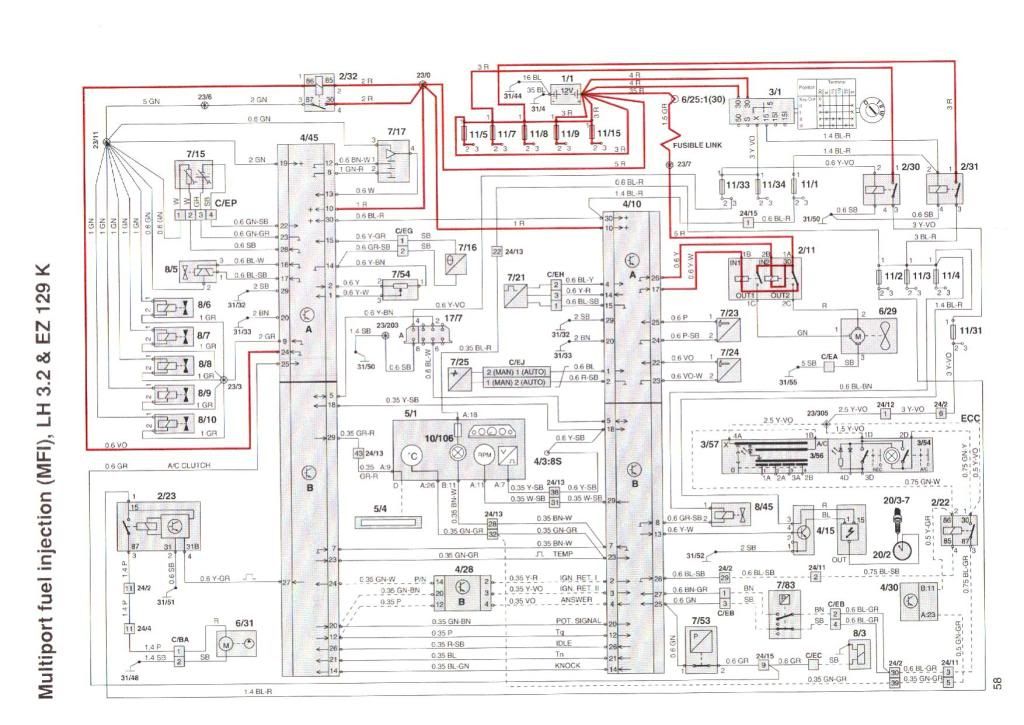
Checked and cleaned the ground points around the engine bay, just to be sure, with no luck.
Leaves me baffled
Induction seems pretty far fetched to me..
850 GLT '92
-
socket_wrench
- Posts: 10
- Joined: 19 December 2011
- Year and Model: 1994 850
- Location: VT
Well, my problem seems to have gone away. I believe it was some kind of weird electronic interference, as far-fetched as this sounds.
I noticed the signal and ground wires to the crank position sensor weren't twisted together helically within the wiring harness. (I assume they should be - this is the norm for most crank position sensors to prevent electronic interference. See ocw.weber.edu/automotive-technology/ausv-1320-automotive-electronics/9-wiring-repair/twisted-pair-wire-repair). Re-twisting the wires and attaching them properly in the wiring harness seemed to immediately solve my problems.
In addition, I cleaned up the grounds on the transmission and behind the starter motor to be safe, but I believe it was the crank position sensor wiring that was causing my issues. I speculate that someone had removed or replaced a sensor prior to my ownership of the car, and done a poor job putting the wiring back.
I noticed the signal and ground wires to the crank position sensor weren't twisted together helically within the wiring harness. (I assume they should be - this is the norm for most crank position sensors to prevent electronic interference. See ocw.weber.edu/automotive-technology/ausv-1320-automotive-electronics/9-wiring-repair/twisted-pair-wire-repair). Re-twisting the wires and attaching them properly in the wiring harness seemed to immediately solve my problems.
In addition, I cleaned up the grounds on the transmission and behind the starter motor to be safe, but I believe it was the crank position sensor wiring that was causing my issues. I speculate that someone had removed or replaced a sensor prior to my ownership of the car, and done a poor job putting the wiring back.
My problems are gone too, finally.
The problem was a bad (aftermarket) starter. Although it cranked the engine just fine, it apparently made so much interference or pulled so much juice that the ECUs went haywire.
The problem was a bad (aftermarket) starter. Although it cranked the engine just fine, it apparently made so much interference or pulled so much juice that the ECUs went haywire.
850 GLT '92
-
danger2manifold
- Posts: 4
- Joined: 26 December 2022
- Year and Model: 1997 Volvo 850
- Location: Edmonton
- Been thanked: 5 times
I wanted to thank previous posters for their detailed troubleshooting descriptions, and add a data point for myself as well.
Over the past 8 months my 350k km 1996 850 Turbo developed an intermittent no-start condition (ie extended cranking without sounding like it was able to catch at all), 1 in 100 times or less. It would always start on the second try, or once I opened the hood to begin checking for spark etc, it would behave. Then the no-starts ramped up, to the point of several per week, luckily always at home or work. Fuel system relays were good, cam and crank sensors were replaced in the past 16 months, so I was baffled when I checked and found I had a no-spark condition. Despite the recent sensors, I checked them anyways, and they had the correct resistances and voltages, and cam sensor would vary appropriately when cranking. Diving into the forums and wiring diagrams, it seemed like I had low voltage to the DI power stage at the coil (multimeter showed 0.27 volts when the troubleshooting guide says to expect 0.7 to 1.3 volts, but looking back maybe my multimeter was filtering out the spikes?). Based on that, I cleaned up the grounds as best I could (without removing the intake manifold), when that didn't improve anything, I bought another ECU to see if swapping would change anything - it didn't. Swapping a junkyard DI stage / coil also didn't do anything.
I wanted to do one last-ditch check before digging in to replace the starter based on the previous posters' interference comments, so I ran a new ground wire from the ECU ground (labeled 31/33 at the front of the block, just above the starter) to the chassis ground just in front of the battery. Keeping in mind I had previously "checked", ie removed and noted only minimal corrosion, ground 31/33 with no effect... with the new ground jumper wire, it fired up immediately and more eagerly than it ever has. So if anyone else out there needs to hear it... checking and cleaning grounds makes allllll the difference on these cars. In my case, I didn't actually clean ground 31/33 effectively enough the first time around, but a jumper ground to the battery cured my laziness.
Over the past 8 months my 350k km 1996 850 Turbo developed an intermittent no-start condition (ie extended cranking without sounding like it was able to catch at all), 1 in 100 times or less. It would always start on the second try, or once I opened the hood to begin checking for spark etc, it would behave. Then the no-starts ramped up, to the point of several per week, luckily always at home or work. Fuel system relays were good, cam and crank sensors were replaced in the past 16 months, so I was baffled when I checked and found I had a no-spark condition. Despite the recent sensors, I checked them anyways, and they had the correct resistances and voltages, and cam sensor would vary appropriately when cranking. Diving into the forums and wiring diagrams, it seemed like I had low voltage to the DI power stage at the coil (multimeter showed 0.27 volts when the troubleshooting guide says to expect 0.7 to 1.3 volts, but looking back maybe my multimeter was filtering out the spikes?). Based on that, I cleaned up the grounds as best I could (without removing the intake manifold), when that didn't improve anything, I bought another ECU to see if swapping would change anything - it didn't. Swapping a junkyard DI stage / coil also didn't do anything.
I wanted to do one last-ditch check before digging in to replace the starter based on the previous posters' interference comments, so I ran a new ground wire from the ECU ground (labeled 31/33 at the front of the block, just above the starter) to the chassis ground just in front of the battery. Keeping in mind I had previously "checked", ie removed and noted only minimal corrosion, ground 31/33 with no effect... with the new ground jumper wire, it fired up immediately and more eagerly than it ever has. So if anyone else out there needs to hear it... checking and cleaning grounds makes allllll the difference on these cars. In my case, I didn't actually clean ground 31/33 effectively enough the first time around, but a jumper ground to the battery cured my laziness.
-
- Similar Topics
- Replies
- Views
- Last post
-
- 3 Replies
- 2517 Views
-
Last post by Roger_850T
-
- 2 Replies
- 2885 Views
-
Last post by ndphotonl