Missed last week? Turbo Upgrades. Take the Fast Friday Poll.
Performance Upgrades vs. Engine Longevity
For most of us our performance car is also likely a daily driver, which means the concern of reduced engine longevity is a real one. Engine repair can be costly and it’s good to know how far you can go before breaking something, but it’s also good to know how much the engine can take without reducing life span -- aside from outright component failure. This week we’ll cover what the Volvo 5 & 6 cylinder engines can and cannot handle in terms of performance and engine life.
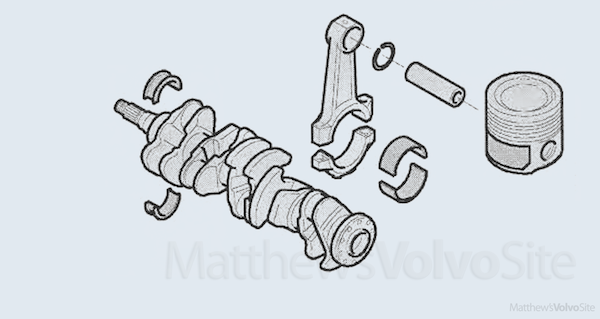
White Block Engines & Durability
The Volvo 5 & 6 cylinder engines, known as the modular N series or ‘White’ block, are fairly similar throughout their range of production however there are some changes as time went by. Most notable is the addition of constant variable valve timing (CVVT) and reduced valve train weight in 1999, as well as a re-design in 2002 that added strength to the rods. These re-designs are commonly known as the revision N or RN for short. The RN blocks are generally agreed to withstand up to an additional 50-75 ft/lbs of torque than the earlier N blocks.
North America, Reclaim Your Horsepower
Stateside our engines are somewhat de-tuned as compared to our European brethren and this comes from differing fuel qualities, emissions standards, and engine equipment. So right off the bat we’re able to increase horsepower without being outside the original design constraints. [Funny little paradox there.] For example take the 1998 model year S70 R that was not produced for US markets but did exist in overseas markets. The base HP for stateside V70 R models was 240bhp while the S70 R was rated at 250bhp. Granted it may not sound like much at 10bhp more but consider this is the max bhp, it does not account for midrange numbers that are higher than 10bhp when compared to the US V70 R with a 16T turbo vs. the Euro S70 R with an 18T turbo. It’s not uncommon to see midrange values as much as 20bhp higher than US cars of the same engine configuration. Additionally consider the nearly 20 ft/lbs of added torque these engines received and you begin to see there’s really quite a bit of room on the table for reclaimed power and performance.
For those who are interested in increasing power output beyond an additional 30-35bhp the question becomes what is the primary point of failure? This varies from engine series so let’s address them by group.
N Series Inline 5-Cylinder 1991-1998
The weak link in these engines tends to be the connecting rods, opinions vary as to what actually will cause rod failure but for the most part it’s agreed that a 300bhp engine is going to perform well day to day without any real concern for reduced longevity or engine damage. This all assumes a properly maintained engine that is in good operational condition before upgrades were installed. Stock pistons are good to approx. 390bhp which is also getting close to the limit of what the stock heads will flow.

RN Series Inline 5-Cylinder 1999-2001
The early version of the RN block have lighter valve train components that is primarily a function of thinner valve stems and a solid valve train vs. the earlier hydraulic system in 1998 and earlier models. Be advised some early 1999 models still had hydraulic lifters so check your engine serial number to be sure. These early RN motors were also better able to handle higher RPM limits and better cylinder head flow from both the CVVT and the thinner valve stems taking up less room in the head intake runners. Rods were still a bit on the weak side which keeps this engine rated to approx. 315bhp in stock form.
RN Series Inline 5-Cylinder 2002-2003
The later RN block from 2002 and later received a longer rod that was also stronger. From 139.5mm in early block, to the 147mm rod in later blocks. This design change not only strengthened the rods by virtue of design improvement but also by the nature of the rod duration. Longer rods stay at TDC for longer periods which extracts more power from a given air/fuel charge. This added benefit, along with the lighter valve train and better flowing heads, allowed these engines to safely make upwards of 340bhp reliably.
RN Series Inline 5-Cylinder 2004-2007
With the addition of the P2R series in 2004 the RN engine was yet again redesigned to increase cooling efficiency and head flow. Dual CVVT along with a number of other changes allows this engine to reach power output up to 400bhp quite easily with supporting components.

Typical power upgrades that increase engine power to 350+bhp are quite common and provide excellent longevity and performance gains. Past 400bhp these engines can be prone to cylinder liner cracking in some scenarios. In this case some folks have opted to use a 2.4L block mated to the R cylinder head to take advantage of the thicker liners the 2.4L engine is equipped with, which is simply a function of reduced bore diameter vs. the 2.5L block that R models were originally equipped with.
Example: 2004 Volvo V70 R and S60 R
- Engine code: B5254T4
- Engine management: Bosch ME 7.01
- Torque: 295 ft-lbs (manual transmission), 258 ft-lbs (auto)
- Power: 300 hp
These engines came in non-turbo and turbo variants with the early blocks showing up on the scene as early as 1991. In non-turbo form, increases in horsepower and torque are somewhat tough and limited. The addition of a turbo, nitrous, or modification of the bore and stroke to gain performance are the more common methods of power increase. In turbo form these engines were quite capable of handling increases of 40bhp with good reliability. With turbo upgrades being a bit less common for these models the conversation around them varies a bit, off the shelf upgrades are farther and fewer between so the limits of the 6 cylinder aren’t as well known by and large. However there are a few users out there pushing these motors past 380bhp on stock internals. Perhaps we’ll see more of this type of upgrade as these engines find themselves transplanted into earlier RWD chassis where the engine bay can more easily accommodate that footprint.

P1 chassis
The Volvo P1 chassis including the C30, V50, C70 2nd gen, and S40 2nd gen, also received a similar engine series with some changes in regard to turbocharger and intake design. These engines are relatively strong and can take performance upgrades quite well. With maximum horsepower figures showing up on the low end of 400bhp we’re seeing some real possibilities with this power plant. Time will tell how far the owner group will plan on taking this chassis but it’s promising to see the aftermarket begin to embrace this car more broadly and with other manufacturers sharing the platform performance components from other lines that are direct fit allow for some easy upgrades albeit somewhat costly at the moment.

With all this said, no matter how strong the engine may be, poor tuning or improperly selected components can still damage an engine. Make sure you choose the right parts for your car and consult with your tuner to ensure a proper setup. Maintenance on engines making higher than stock levels of performance is critical, if you don’t maintain the engine... don’t expect it to last.
Robert Lucky Arnold
~ ~ ~
- Questions, comments, arguments and freakouts accepted and encouraged. Really. Lucky WANTS to answer your questions.
- If you want to remain anonymous, email me your question or comment and I will post it as "Anonymous User".
- It takes Lucky and me several hours combined to bring you Fast Fridays. Your questions and comments validate FF's value.
- I write paragraph headlines, and sometimes article headlines. Yell at me if you find these not to your taste.
- Same thing with italics and bolds , they're all mine.
- Cams and turbos and MBCs and chips and... whoo!
Matt