


My 2004 S60 2.5T FWD displayed a "Low Oil Pressure warning light" to my surprise. I pulled over checked oil level and ok. The light went off then back on but only once the car was warmed up and if revving the engine (only to 1,400 give or take). I speculate that the oil pump intake filter could be the culprit. I changed the oil following the warning light incident. The old oil was pretty dirty I have to say having been changed about 7,000 miles earlier. I noticed little metal filings (very small) on the bottom of my oil collection pan and assume this is normal for a S60 with 110,000 miles.
Basically:
1) Took the car to a pretty competent mechanic who I have dealt with in the past. I did not state my speculations of the problem. He returned a call to me and stated that he thinks the filter on the oil pump intake is pretty much clogged with old oil deposits and muck. He stated that the same, the light comes on only after warming up and that there is valve clatter once the car warms up as oil is not getting up into the top of the engine. And as well- that the oil pressure drops as the engine warms as he checked with a manual oil pressure gauge.
2) The mechanic states that he would charge 6 hours of labour + synthetic oil, filter, new "O" ring replacements and $85.00 for the oil pump strainer. Thus about $800.00.
3) I am confident working on Volvos having owned 3 and have done everything from brakes, fuel pumps to the fuel injection unit replacement. Pretty good garage area and tool assortment. Would this be a difficult task- to drop the oil pan, clean the sludge, replace the "O" rings and all- after reading some of the excellent instructions added to the database?
Thank You in advance....
2004 S60 Oil Pan Removal & Low Oil Pressure warning light Topic is solved
-
Erikinstockholm
- Posts: 8
- Joined: 09 Nov 2009, 13:10
- Year and Model: 2001 S 80
- Location: Westchester NY
-
northernlights
- Posts: 251
- Joined: 12 Oct 2012, 22:49
- Year and Model: 850 Turbo 1994
- Location: Florida and/or Raleigh NC, depending on the day
- Been thanked: 8 times
In my experience it's always worth trying heavier oil in this situation. All engines have a certain design flow past the main bearings because the sides of the main bearings are essentially controlled leaks into the oil pan. As engines wear this increase in clearance creates an increase in oil flow from the crank to the pan so the pressure in the system drops downstream of the wear.
Higher viscosity oil reduces the rate of the leak and can recover some amount of pressure. The thing to keep in mind is that the hot viscosity of oil is what counts in this case. You didn't mention what viscosity you are using, but something like 5W-20 in an old engine is a bad idea. This is from Volvo Australia for the 2004 V70 - same engines as we get in the USA but with a real list of viscosities compared to the USA numbers which follow. Your engine will not explode using heavier oil if the ambient temperatures are reasonable and the engine is not thrashed cold. As the attached shows, 15W40 actually has a pretty wide temperature range. Remember - W is for winter!

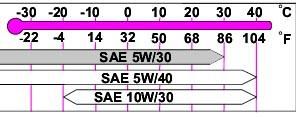
Higher viscosity oil reduces the rate of the leak and can recover some amount of pressure. The thing to keep in mind is that the hot viscosity of oil is what counts in this case. You didn't mention what viscosity you are using, but something like 5W-20 in an old engine is a bad idea. This is from Volvo Australia for the 2004 V70 - same engines as we get in the USA but with a real list of viscosities compared to the USA numbers which follow. Your engine will not explode using heavier oil if the ambient temperatures are reasonable and the engine is not thrashed cold. As the attached shows, 15W40 actually has a pretty wide temperature range. Remember - W is for winter!


-
Erikinstockholm
- Posts: 8
- Joined: 09 Nov 2009, 13:10
- Year and Model: 2001 S 80
- Location: Westchester NY
Hi Forum Members,
FIRST Thanks Northernlights for the in-depth answer. I will pass this on to my mechanic. And as you ask Frothberg, so far the car is still at the mechanic.
1) I actually swapped mechanics, although the mechanic I noted earlier is competent and I assume pretty straight, I felt the cost was too high. I drove the car down the road to another mechanic recommended by three friends. The guy is very straight and it is apparent.
2) He took the Oil Pan off and said he was shocked to see the sludge build up. He said that it was the worst he had seen in ages. I also was in shock to see it. Basically it is assumed the previous owner did not use synthetic and may have driven long time periods w/o changing the oil. The mechanic said that the screen filter protector for the oil pump did not appear to be clogged, had some debris on it but not enough to warrant the oil pressure light to come on. He cleaned the oil pan, gave it a bath, as well as the filter and reinstalled and added oil. The car idled for about 20 minutes and AGAIN the <Low oil pressure light > came on. The mechanic said he is shocked! Has had a number of Volvos, never heard of something like this.
3) He says the next step would be to change the pump at $310 USD and when doing so might as well do the timing chain. He spoke to our local Volvo dealer (same town) and the parts manager/repair said the chances of a Volvo oil pump going bad at 105k is nearley unheard of.
Side note- the cost for the initial job of removing the oil pan, cleaning and install would have been 1/2 that of the other mechanic.
Perhaps good to have the mechanic drain the new oil and try a higher viscosity? I am in the NY area so temperatures range is 25 to 100 (these as extremes).
Thank You for your insight and any further info would be greatly appreciated.
FIRST Thanks Northernlights for the in-depth answer. I will pass this on to my mechanic. And as you ask Frothberg, so far the car is still at the mechanic.
1) I actually swapped mechanics, although the mechanic I noted earlier is competent and I assume pretty straight, I felt the cost was too high. I drove the car down the road to another mechanic recommended by three friends. The guy is very straight and it is apparent.
2) He took the Oil Pan off and said he was shocked to see the sludge build up. He said that it was the worst he had seen in ages. I also was in shock to see it. Basically it is assumed the previous owner did not use synthetic and may have driven long time periods w/o changing the oil. The mechanic said that the screen filter protector for the oil pump did not appear to be clogged, had some debris on it but not enough to warrant the oil pressure light to come on. He cleaned the oil pan, gave it a bath, as well as the filter and reinstalled and added oil. The car idled for about 20 minutes and AGAIN the <Low oil pressure light > came on. The mechanic said he is shocked! Has had a number of Volvos, never heard of something like this.
3) He says the next step would be to change the pump at $310 USD and when doing so might as well do the timing chain. He spoke to our local Volvo dealer (same town) and the parts manager/repair said the chances of a Volvo oil pump going bad at 105k is nearley unheard of.
Side note- the cost for the initial job of removing the oil pan, cleaning and install would have been 1/2 that of the other mechanic.
Perhaps good to have the mechanic drain the new oil and try a higher viscosity? I am in the NY area so temperatures range is 25 to 100 (these as extremes).
Thank You for your insight and any further info would be greatly appreciated.
-
northernlights
- Posts: 251
- Joined: 12 Oct 2012, 22:49
- Year and Model: 850 Turbo 1994
- Location: Florida and/or Raleigh NC, depending on the day
- Been thanked: 8 times
Assuming the last oil change ended up with 5W30, then I certainly would. Mobil1 10W40 high mileage synthetic has good hot viscosity, 12.7 cP at 100C, and meets the ACEA A3 spec which is what Volvo recommends for the rest of the world for severe service. For comparison, regular Mobil1 5W30 is about 9.4 cP, and that's a decent 5W30. The high mileage Mobil1 5W30 is about 10 cP. Very good for a 5W30, but not as good as that 10W40 I mentioned.Erikinstockholm wrote: Perhaps good to have the mechanic drain the new oil and try a higher viscosity? I am in the NY area so temperatures range is 25 to 100 (these as extremes).
About 25 years ago, in Massachusetts, for a time I used conventional 20W50 in a high revving domestic V8 to keep the oil consumption reasonable. As winter approached, I did notice the car start to crank a little slower than usual, but I didn't worry much about it until one chilly January morning I had an 'event'. After driving off without much warmup (driving the car brought the heat up faster!), I noticed that when accelerating I was able to make my oil pressure gauge drop from about 60 psi to zero!
I pulled over, turned off the car, checked the oil, and found the pan full. I came to the conclusion that it was so cold that either the oil flow was too low (due to cold thick oil) to supply the engine much higher than idle, or if it was flowing, then all of the oil was being pumped into the heads and was too thick to drain back into the pan before the pan momentarily ran dry. I suspect it was the former, but who knows for certain
I warmed the car up a bit and drove off without drama. Later that day I changed the oil to 10W40 and the problem went away. Considering your problem, even with winter coming I can't see you going wrong with a good 10W40 like that high mileage Mobil1.
-
Erikinstockholm
- Posts: 8
- Joined: 09 Nov 2009, 13:10
- Year and Model: 2001 S 80
- Location: Westchester NY
Thanks for the follow up. Makes good sense and will be great to try first, before opening up for a pump. I will provide some follow up later.
Regards
Regards
-
precopster
- Posts: 7543
- Joined: 21 Aug 2010, 00:20
- Year and Model: Lots
- Location: Melbourne Australia
- Has thanked: 8 times
- Been thanked: 128 times
The O rings Mike mentioned are SO important; I wouldn't consider dropping an oil pan without replacement of them.
Perhaps the problem was solved by cleaning the sludge and now you're dealing with flattened out non-sealing O rings which should have been replaced after being disturbed.
+1 on trying a different ooil viscosity. My wife and I purchased our first non turbo 850 during hot weather almost 5 years ago and found the oil pressure light on during idle after warmup.
New semi synthetic oil of 10W/40 was fitted and regularly replaced and the light has never returned.
Perhaps the problem was solved by cleaning the sludge and now you're dealing with flattened out non-sealing O rings which should have been replaced after being disturbed.
+1 on trying a different ooil viscosity. My wife and I purchased our first non turbo 850 during hot weather almost 5 years ago and found the oil pressure light on during idle after warmup.
New semi synthetic oil of 10W/40 was fitted and regularly replaced and the light has never returned.
Current cars VW Transporter 2.5TDI, 2010 XC90 D5 R Design
-
oragex

- Posts: 5347
- Joined: 24 May 2013, 06:20
- Year and Model: S60 2003
- Location: Canada
- Has thanked: 102 times
- Been thanked: 352 times
- Contact:
The sludge appears usually from a clogged PCV system. The oil pump should have been inspected.
This might cause rod bearings to fail, which triggers the oil pressure light. It's a typical issue with Volvos.
This might cause rod bearings to fail, which triggers the oil pressure light. It's a typical issue with Volvos.
Several Volvo Repair Videos https://www.youtube.com/playlist?list=P ... s0FSVSOT_c
-
Erikinstockholm
- Posts: 8
- Joined: 09 Nov 2009, 13:10
- Year and Model: 2001 S 80
- Location: Westchester NY
Thanks fir the lead, I will pass that on to the mechanic.
Appreciated!
Appreciated!
-
- Similar Topics
- Replies
- Views
- Last post
-
- 2 Replies
- 1363 Views
-
Last post by dhollow2
-
- 3 Replies
- 1750 Views
-
Last post by traudesa
-
- 2 Replies
- 1511 Views
-
Last post by Salomons Driveway
-
- 0 Replies
- 976 Views
-
Last post by 2521cc
-
- 2 Replies
- 1334 Views
-
Last post by mkbell2000