


So for the past three years of owning my 1998 Volvo, I have had a consistent minor seepage at what I believe is the RMS based on various sites I’ve visited and read. It’s a consistent oil moisture right below the trans / engine junction on the drivers side.
It’s a non turbo motor, with 252K on it. Runs good no issues. Timing belt and exhaust manifold have been replaced during my ownership, but haven’t had the funds and or time to do the PCV system even though I’m sure it could use it.
As I said, I’m not seeing any increase in oil consumption / leakage in the last three years. Assuming it is the RMS can these stay stable for awhile and then just burst or do they tend to just seep when they leak?
I had plans of buying another lower mileage NA white block and slowly rebuilding it in my spare time in my storage room. I would do the timing belt, the PCV and maybe even a head gasket / valve job. Just take my time and do it right. Then, when or if this current motor finally gives way, I could pay someone to install the rebuilt motor in my car and just keep on going with it. I could probably find a salvage motor for between $400-$600 in my area, and I figured at least another $500-600 for timing belt kit, PCV kit and other odds and ends. Plus labor to install a motor, I feel that’s still probably less than what would be required to put down to lease a new car. Then I’d have a much lower mile motor with everything done right prior to going back in the car.
Part of my rationale for this is that I can’t have the downtime to do all these repairs in my car because I depend on it everyday. But I could spend a few hours a week for the next several months to slowly recondition a stationary motor for an eventual swap.
My other thought would be to find a lower mile, tighter 1998 V70 and just use mine for parts. I’ve spent consider time and effort to add lots of nice accessories to mine and I hate the thought of losing out on those of this one does die for whatever reason. Complete XC roof rack, repaired or replaced all seats, added fog lamps, new headliner, OEM all weather mats...the equivalent of weeks in the junkyards finding all this stuff. I’d like to have a backup with lower miles and perhaps a trashed interior and stuff that I could transfer my good accessories to, and then canabalize the rest of the chassis for other parts like all door hardware, functional engine compartment bolt-ons, door glass, mirrors, door panels, etc.
I would like to drive a 1998 V70 for another 10 years or more. Just not sure how best to make that happen.
Let me know if I sound crazy, brilliant or stupid. Thanks.
Doctor...how long do I have? RMS and other odds and ends
-
SonicAdventure

- Posts: 442
- Joined: 03 Jul 2015, 09:43
- Year and Model: 1996 850 wagon
- Location: America
- Has thanked: 59 times
- Been thanked: 12 times
-
tryingbe
- Posts: 1893
- Joined: 18 Jun 2009, 12:43
- Year and Model: None
- Location: Mesa, AZ, USA
- Has thanked: 1 time
- Been thanked: 26 times
I would suggest you skip the "rebuild another whiteblock" plan and do your PCV ASAP. PCV service kit is cheap if you use my below plan.
Keep the timing belt change, PCV system clear, oil full/change, and good fuel in your car and the engine will outlast the car.
Keep the timing belt change, PCV system clear, oil full/change, and good fuel in your car and the engine will outlast the car.
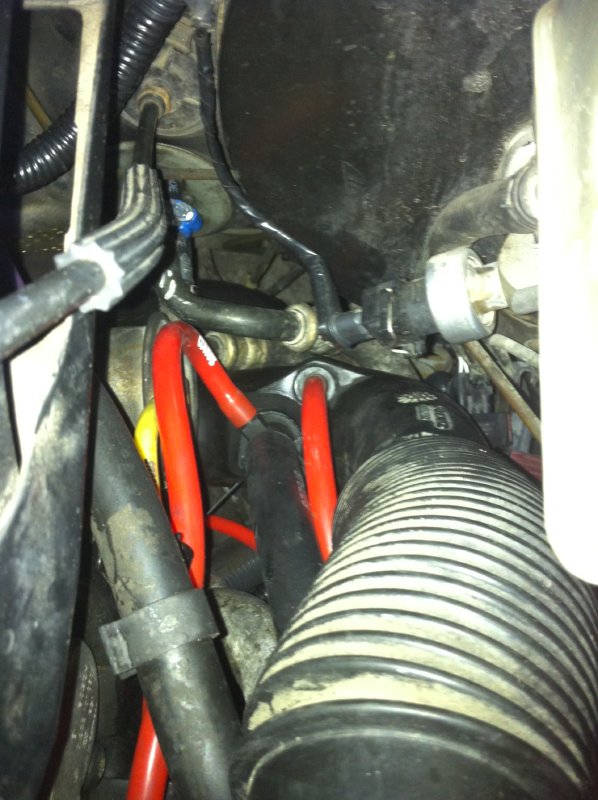
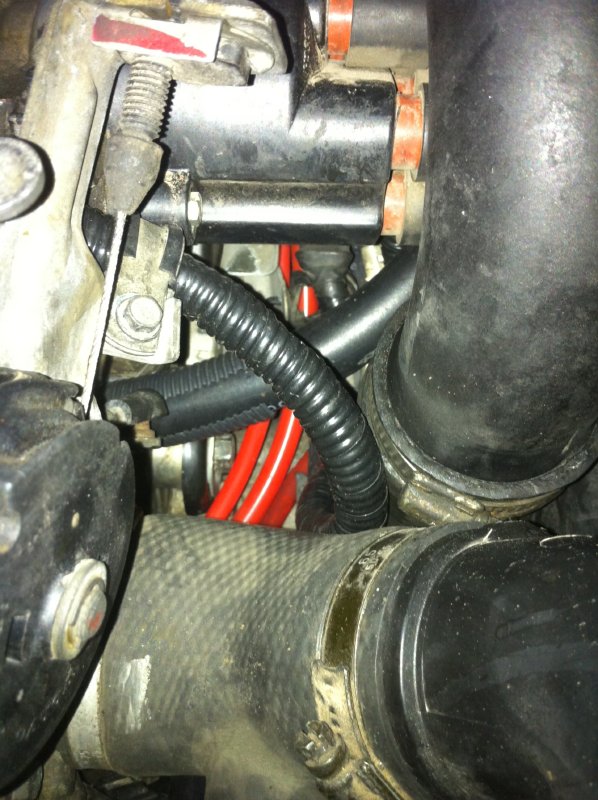
tryingbe wrote: 01 Jul 2016, 20:31 I found with the older engines, even with new PCV parts, it is not enough. The stock PCV pipe from the separator to the intake is severely undersized for an older engine. Also, the hole at the heating element at the PTC valve is tiny, like smaller than 1/4 inch tiny. Both will restrict the flow of the crankcase gases.
To address those issues, here is what I do. Get the below parts.
A 3ft 5/8 oil compatible hose. Do not use silicone hose, as it will "sweat" oil. Do not use heatercore hose, it is not rated for oil, it will become soft and you'll have to replace it sooner. This is what I use. Buy 3, as it is sold by the foot.
http://www.ebay.com/itm/291442927889?_t ... EBIDX%3AIT
One 3/4 elbows from your local hardware store. (5/8 will be the wrong size!)
A 3 feet 3/16 inch or 1/4 inch vacuum hose to replace the small hose from the intake manifold to the PTC valve. I prefer silicone hose for this.
Optional, get 6 of this. I like their clamps.
https://www.ipdusa.com/products/4768/10 ... 12mm-width
Optional, wireloom to protect the hose.
Take a unibit and drill out the PTC valve holes to as big as you feel comfortable. I think I drilled mine out to about 1/2 inch.
Remove the intake manifold and replace that stock PCV hose, I cut a short hose and then use a 90 degree elbow, than a long hose to the PTC valve. Replace the vacuum hose to the intake manifold to the PTC valve with the new one. Then reinstall the intake manifold.
All the crankcase gas have to go thru that tiny PTC hole!!!
Installed on car


85 GLH, 367 whp
00 Insight, 72 mpg
00 Insight, 72 mpg
-
SuperHerman

- Posts: 1798
- Joined: 01 Dec 2014, 13:28
- Year and Model: 2004 & 2016 XC90
- Location: Minnesota
- Been thanked: 207 times
Excessive pressure will cause oil to leak from the RMS. Check your PCV system for excess pressure and if it has it, do your PCV system and see if your RMS leak stops or at least slows down.
RMS will not "blow" it will just leak more and more as the miles keep going up and the seal and crank wears. To replace it you have two options 1) pull engine or 2) pull transmission. The RMS part is not too expensive but the labor to remove the engine or transmission is.
If you have skills and tools you can get it done in a weekend, but I would not do the RMS and not do the PCV system or at least inspect it for excess pressure. If you have excess pressure it will leak out the weakest seal.
RMS will not "blow" it will just leak more and more as the miles keep going up and the seal and crank wears. To replace it you have two options 1) pull engine or 2) pull transmission. The RMS part is not too expensive but the labor to remove the engine or transmission is.
If you have skills and tools you can get it done in a weekend, but I would not do the RMS and not do the PCV system or at least inspect it for excess pressure. If you have excess pressure it will leak out the weakest seal.
-
Clemens

- Posts: 1954
- Joined: 03 Sep 2015, 12:34
- Year and Model: 96 855 R + 94 855 T5
- Location: Austria
- Has thanked: 498 times
- Been thanked: 228 times
If you don't have time to do the pcv, don't get started on a motor rebuikd, i'd say.
I would suggest doing the pcv and once you get good vacuum add a bottle of atp 205 to the engineboil. This worked perfectly for me, the rms stopped leaking
I would suggest doing the pcv and once you get good vacuum add a bottle of atp 205 to the engineboil. This worked perfectly for me, the rms stopped leaking
1996 855 R,
black on black, M56 swapped, Quaife, TME 2.5 exhaust, 17 inch Volants
2010 V70 D5,
Saville Gray on tan leather, 18 inch Odysseus
black on black, M56 swapped, Quaife, TME 2.5 exhaust, 17 inch Volants
2010 V70 D5,
Saville Gray on tan leather, 18 inch Odysseus
-
SonicAdventure
- Posts: 442
- Joined: 03 Jul 2015, 09:43
- Year and Model: 1996 850 wagon
- Location: America
- Has thanked: 59 times
- Been thanked: 12 times
Ugh, I guess I just have to get it together to do the PCV if I want to keep the car.
I have watched many good videos on this topic but there always seems to be something missing.
First of all, with regards to not using the “kit” hoses but the larger diameter ones with elbows, none of the links in that quote above are active.
Is there a kit for the older wider diameter hoses, or if not, where is the best place to source them? Also if I buy the larger diameter hoses separately, what would I need to buy as a kit from FCP, just the oil trap box and the intake manifold gasket?
If I’m going to do this, ideally I would replace every vacuum line down there while I’m at it. I wish someone just sold a kit for the higher mileage cars. I know at one point RSPI was making copper tubes for this job, RSPI if you see this are you still doing that and if so, how much are your tubes?
I have watched many good videos on this topic but there always seems to be something missing.
First of all, with regards to not using the “kit” hoses but the larger diameter ones with elbows, none of the links in that quote above are active.
Is there a kit for the older wider diameter hoses, or if not, where is the best place to source them? Also if I buy the larger diameter hoses separately, what would I need to buy as a kit from FCP, just the oil trap box and the intake manifold gasket?
If I’m going to do this, ideally I would replace every vacuum line down there while I’m at it. I wish someone just sold a kit for the higher mileage cars. I know at one point RSPI was making copper tubes for this job, RSPI if you see this are you still doing that and if so, how much are your tubes?
-
SonicAdventure
- Posts: 442
- Joined: 03 Jul 2015, 09:43
- Year and Model: 1996 850 wagon
- Location: America
- Has thanked: 59 times
- Been thanked: 12 times
The only advantage of starting to put a new motor together separately is that i won’t lose the down time on my car. I’m the kind of person who likes to take time and not rush to do repairs like this. The downtime of my main transportation is a real issue. And we all know that no matter how well you prepare, there is always some hose that breaks, or extra tool you need and when your only car is down, you are walking to the auto parts store and that ain’t close in my neighborhood.Clemens wrote: 20 May 2018, 16:44 If you don't have time to do the pcv, don't get started on a motor rebuikd, i'd say.
I would suggest doing the pcv and once you get good vacuum add a bottle of atp 205 to the engineboil. This worked perfectly for me, the rms stopped leaking
If I could slowly put a motor together over a 6 month period that would be better.
-
FLXC90
- Posts: 1132
- Joined: 18 Aug 2014, 16:31
- Year and Model: 98 V70 T5
- Location: Florida Panhandle
- Has thanked: 16 times
- Been thanked: 45 times
Do the PCV, it is buying the time to build a spare motor, otherwise, as you know, the RMS will go the week before you would have had the other motor ready. The AT 205 will flex up the seal, but first you need to relieve the pressure. The AT 205 may also soften and recondition your valve stem seals. Then seafoam your top-end through the intake tract, and you will be good to go for a long while.
As far as the links, look up cn90s ultimate PCV thread
viewtopic.php?f=1&t=53448#p267978
As far as the links, look up cn90s ultimate PCV thread
viewtopic.php?f=1&t=53448#p267978
Current Volvos:
1998 V70 T5, 112k sat 5 years, still in mechanical coma (finally at the top of the pile )
2004 XC90 T6 AWD: 186k, 60 on transaxle ( traded in )
1998 POS70 N/A: DD/training aid, 236k but really about 240k, I think...ABS module( passed on to son who sold it)
1998 V70 T5, 112k sat 5 years, still in mechanical coma (finally at the top of the pile )
2004 XC90 T6 AWD: 186k, 60 on transaxle ( traded in )
1998 POS70 N/A: DD/training aid, 236k but really about 240k, I think...ABS module( passed on to son who sold it)
-
tryingbe
- Posts: 1893
- Joined: 18 Jun 2009, 12:43
- Year and Model: None
- Location: Mesa, AZ, USA
- Has thanked: 1 time
- Been thanked: 26 times
Three are pictures with the hose part number and descriptions on what you need to get. You have google, ebay, amazon, and etc. at your finger tips, figure it out.SonicAdventure wrote: 20 May 2018, 20:26
First of all, with regards to not using the “kit” hoses but the larger diameter ones with elbows, none of the links in that quote above are active.
85 GLH, 367 whp
00 Insight, 72 mpg
00 Insight, 72 mpg
-
abscate

- MVS Moderator
- Posts: 36145
- Joined: 17 Feb 2013, 17:54
- Year and Model: 99: V70s S70s,05 V70
- Location: Port Jefferson Long Island NY
- Has thanked: 1609 times
- Been thanked: 4065 times
Do take care of that RMS before it blows out - by doing the PCV.
My doctor gave me six months to live - couldn't pay his bill - gave me another six months...
My doctor gave me six months to live - couldn't pay his bill - gave me another six months...
Empty Nester
A Captain in a Sea of Estrogen
1999-V70-T5M56 2005-V70-M56 1999-S70 VW T4 XC90-in-Red
Link to Maintenance record thread
A Captain in a Sea of Estrogen
1999-V70-T5M56 2005-V70-M56 1999-S70 VW T4 XC90-in-Red
Link to Maintenance record thread
-
JimBee
- Posts: 1938
- Joined: 09 Dec 2008, 21:23
- Year and Model: 93 and 2 96 850's
- Location: Minneapolis
- Has thanked: 33 times
- Been thanked: 43 times
Ideally, do the renewal as described above. If time or inclination doesn't permit, you could try what I did.
A really quick fix that worked for me is: 1) clean out your ptc. Anything above 150k miles, it's almost surely clogged. If the hose is clogged, well, gases aren't getting to the ptc. If there's a screen in it, toss the screen. I was prepared to do the renewal as my rms and a couple of camshaft seals that I'd replaced not too long prior had been leaking. So I did 1) as noted. Then on a fresh full synthetic oil change, 2) I added half a can of Seafoam to the crankcase and ran it for a season, leaving the Seafoam in the oil. It now passes the glove test and oil leaks have stopped. It's worth a try.
I suspect the Seafoam off-gassing through the PCV system dissolved some of the buildup there. Just a guess. It is a solvent. It's also possible that it helps to dissolve carbon built up in the cylinder walls.
A really quick fix that worked for me is: 1) clean out your ptc. Anything above 150k miles, it's almost surely clogged. If the hose is clogged, well, gases aren't getting to the ptc. If there's a screen in it, toss the screen. I was prepared to do the renewal as my rms and a couple of camshaft seals that I'd replaced not too long prior had been leaking. So I did 1) as noted. Then on a fresh full synthetic oil change, 2) I added half a can of Seafoam to the crankcase and ran it for a season, leaving the Seafoam in the oil. It now passes the glove test and oil leaks have stopped. It's worth a try.
I suspect the Seafoam off-gassing through the PCV system dissolved some of the buildup there. Just a guess. It is a solvent. It's also possible that it helps to dissolve carbon built up in the cylinder walls.
-
- Similar Topics
- Replies
- Views
- Last post