Login Register

98 v70 NA evap canister shut off valve

Help, Advice and DIY Tutorials on Volvo's P80 platform cars -- Volvo's 1990s "bread and butter" cars -- powered by the ubiquitous and durable Volvo inline 5-cylinder engine.

1992 - 1997 850, including 850 R, 850 T-5R, 850 T-5, 850 GLT
1997 - 2000 S70, S70 AWD
1997 - 2000 V70, V70 AWD
1997 - 2000 V70-XC
1997 - 2004 C70

Post Reply
98v70dad
Posts: 1226
Joined: 11 March 2011
Year and Model: 98 V70
Location: Southeast US
Has thanked: 1 time

Re: 98 v70 NA evap canister shut off valve

Post by 98v70dad »

cn90 wrote:Volvo PN 9135805 is about $110-$120 at Volvo dealer.
But I rarely see a bad one in this forum.

What brand did you use 2 years ago?
If I remember right I bought it at the dealer for $122 - blue box OEM (I need to start keeping records). A dealer part should last the same length of time as the original in my opinion, although I know that there are occasional outliers that will fail early. The function of this part is pretty simple so I doubt there is anything else wrong that caused the failure ... the part just quit.

Based on my symptoms before it went out I would guess that the valve is stuck (jammed). At first it stuck closed, then it leaked a bit for a few weeks (small leak codes) then it stuck open (large leak - P0455). I never suspected it because it was new. This is why I would not make a good living as an auto mechanic. They deserve more respect that people give them.

I buy parts from authausaz, IPD (rarely) and FCP Euro but almost always from the dealership since they are usually only a couple of dollars more and I can have them in hand the next day at the latest.

I shop the price and then decide but usually go with the dealer for convenience.

User avatar
abscate
MVS Moderator
Posts: 35278
Joined: 17 February 2013
Year and Model: 99: V70s S70s,05 V70
Location: Port Jefferson Long Island NY
Has thanked: 1500 times
Been thanked: 3812 times

Post by abscate »

You are going to win the MaVerickS award for the longest grinding down a problem to its essence, well done.
Empty Nester
A Captain in a Sea of Estrogen
1999-V70-T5M56 2005-V70-M56 1999-S70 VW T4 XC90-in-Red
Link to Maintenance record thread

kahl
Posts: 943
Joined: 27 October 2012
Year and Model: 2000V70XC
Location: columbus ohio
Been thanked: 10 times

Post by kahl »

I am with ya, love OPs determination. FWIW FCP sold 3 of these vent valves in 2015 and 3 in 2014. If it has failed let me know and I will send you one of my spares for postage. It ops checked perfectly. The sequence of no leak to small leak to large leak sounds like a hose failing.

98v70dad
Posts: 1226
Joined: 11 March 2011
Year and Model: 98 V70
Location: Southeast US
Has thanked: 1 time

Post by 98v70dad »

abscate wrote:You are going to win the MaVerickS award for the longest grinding down a problem to its essence, well done.
The fact that the shut off valve acts as a check valve was news to me until today. Suddenly it all makes sense.

I'm sorry that I have written so many posts about it, but I just want to get it fixed and I can't stand the fact that so far I've been unsuccessful. That said, now nearly everything is new.

98v70dad
Posts: 1226
Joined: 11 March 2011
Year and Model: 98 V70
Location: Southeast US
Has thanked: 1 time

Post by 98v70dad »

kahl wrote:I am with ya, love OPs determination. FWIW FCP sold 3 of these vent valves in 2015 and 3 in 2014. If it has failed let me know and I will send you one of my spares for postage. It ops checked perfectly. The sequence of no leak to small leak to large leak sounds like a hose failing.

Thanks for the offer. That's very generous of you.

I know that it sounds like a hose leak, but I replaced the hose with thick walled 3/8 heater hose just 2 years ago. Its pretty tough stuff. Its more likely that the hose came off in my opinion, but I'm pretty sure I put a hose clamp on it because the ID of the heater hose was a little bigger than the original hose. I used a cheap hose clamp from Advance Auto and its possible that the clamp cut through the hose .... we'll find out.

User avatar
sleddriver
Posts: 975
Joined: 8 April 2010
Year and Model: 1998 V70 T5
Location: Tx
Has thanked: 11 times
Been thanked: 12 times

Post by sleddriver »

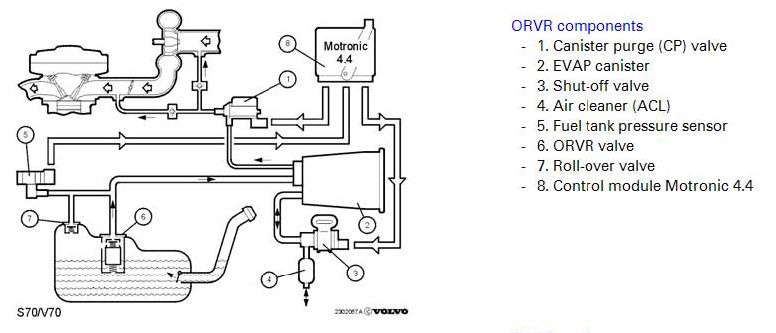
Image

Onboard Refueling Vapor Recovery (ORVR) Components:

-1. Canister purge (CP) valve
-2. EVAP canister
-3. Shut-off valve
-4. Air cleaner (ACL)
-5. Fuel tank pressure sensor
-6. ORVR valve
-7. Roll-over valve
-8. Control module Motronic 4.4

EVAP canister
Hydrocarbon vapor pressed out of the fuel tank is dealt with by the EVAP canister. To minimize pressure drop in the lines between the fuel tank and EVAP canister, the EVAP canister is located close to the fuel tank. The EVAP canister volume is 2.1 liters. A new type of carbon reduces pressure drop in the gas flowing through the EVAP canister.

ORVR valve
There is a combined float roll-over valve by the connector for the large EVAP line to the fuel tank (called the ORVR valve). As its name implies it has two functions.

-a roll-over function which closes the large EVAP line connector so that fuel cannot leak out if the car is on its side or roof.
-a float valve function which closes the large EVAP line connector when the fuel level reaches the valve when the fuel tank is full

Roll-over valve
A small EVAP line runs from the ORVR valve to a roll-over valve located as high as possible on the fuel tank. The roll-over valve ensures that the fuel tank can breath if the ORVR valve is closed when the car has been refueled.

Pressure sensor
The pressure sensor provides information about pressure in the fuel tank. The sensor is connected to a Y pipe from the ORVR valve.
The pressure sensor also obtains the fuel tank pressure via the roll-over valve if the ORVR valve is closed.

EVAP canister shut-off valve
The valve is located close to the EVAP canister. The valve is part of the leak diagnostic system and temporarily closes the EVAP canister fresh air intake during the diagnostic test.

Filter
The filter is located by the fuel filler pipe and is connected to the EVAP canister shut-off valve via a hose.

Canister purge (CP) valve
This valve controls the flow of fuel vapor and air from the EVAP canister to the engine. The valve is controlled by the engine control module (ECM).

EVAP line
The line between the EVAP canister and fuel tank has been replaced by a large 13.5 mm line.
This allows fuel vapor to move easily between the fuel tank and EVAP canister when the car is refueled.

Fuel tank filler cap
The fuel tank filler cap has a overpressure/vacuum valve.

Check valve
The check valve at the bottom of the filler pipe on cars with ORVR is the same as that on AWD cars.

System description:

When refueling starts the check valve in the fuel tank opens. The fuel flow creates negative pressure at the top of the fuel filler pipe. This results in an air flow in the fuel filler pipe. It is important to have low resistance between the fuel tank and atmospheric pressure (via the EVAP canister shut-off valve filter) to stop fuel vapor escaping from the fuel filler pipe. The principle of the system is called a dynamic seal.

When the fuel tank is full the ORVR valve closes and the fuel tank pressure increases rapidly. This closes the check valve in the fuel tank, preventing fuel coming out of the filler pipe when the fuel pump pistol is shut off.

Fuel vapor in the fuel tank (together with air) reach the EVAP canister via the ORVR valve. Fuel vapor is absorbed by the carbon in the EVAP canister. If the ORVR valve is closed the fuel tank is vented via the roll-over valve.

When the canister purge (CP) valve is closed the fuel vapor remains in the EVAP canister.

When the engine control module (ECM) transmits an opening signal to the valve, a vacuum from the intake manifold or from the fresh air intake creates a flow through the EVAP canister. The EVAP canister is connected to the outside atmosphere via the canister shut-off filter which allows the flow to evacuate the EVAP canister.

The air flow through the EVAP canister removes stored fuel vapor which flow to the engine and enter the combustion process. The canister purge (CP) valve pulses rapidly when the car is being driven and is idling.


Diagnostics are carried out as follows:

The EVAP canister shut-off valve and canister purge (CP) valve are closed and the fuel tank system is now completely closed.

Pressure in the fuel tank should be stable. If pressure drops the canister purge (CP) valve is leaking.

The EVAP canister shut-off valve opens, the tank system is open. The canister purge (CP) valve is pulsed and because of the negative pressure in the intake manifold the engine starts to suck air through the EVAP canister. Because the EVAP canister shut-off valve is open the pressure in the fuel tank drops slowly. If the pressure in the fuel tank drops rapidly the EVAP canister shut-off valve is clogged.

The EVAP canister shut-off valve is closed, the canister purge (CP) valve continued to be pulsed, pressure in the fuel tank should drop rapidly. If pressure does not drop enough there is a large leakage in the fuel tank system. A diagnostic trouble code (DTC) will be stored.

The canister purge (CP) valve is closed, the EVAP canister shut-off valve is still closed, there is negative pressure in the fuel tank.

The negative pressure (A) in the fuel tank has stabilized, if pressure starts to increase too quickly, this indicates a small leakage in the system. A diagnostic trouble code (DTC) is stored.

The EVAP canister shut-off valve opens, the EVAP function is enabled and the diagnostic test is finished.

To carry out the diagnostic:

-engine coolant temperature (ECT) is between -10OC and +107OC.
-no permanent faults stored.
-engine idling.
-speed must be 0 km/h.
-the concentration of fuel vapor in the canister must not be too high.
-there must be more than 11 liters of fuel in the tank
-the pressure in the fuel tank must not be too high.
-fuel trim must be active.
-the car must be below 2700 meters above sea level.

The diagnostic test starts at the earliest 17 minutes after the engine has been started when all conditions have been met. It takes approximately 30 seconds.[/quote]
1998 V70 T5 226,808 miles. Original Owner.
M1 10W-30 HM

User avatar
sleddriver
Posts: 975
Joined: 8 April 2010
Year and Model: 1998 V70 T5
Location: Tx
Has thanked: 11 times
Been thanked: 12 times

Post by sleddriver »

98v70dad wrote:The fact that the shut off valve acts as a check valve was news to me until today. Suddenly it all makes sense. I'm sorry that I have written so many posts about it, but I just want to get it fixed and I can't stand the fact that so far I've been unsuccessful. That said, now nearly everything is new.
I don't concur that it does. I posted a detailed explanation of the system + diagram above. Hope that helps. Also I gave my rationalle on your other post as to why there is no air check-valve in the vent you refer to .

When pressure testing/smoking my EVAP system, I had to plug the VENT port, coming from the SHUT-OFF valve so the tank, charcan, etc., would pressurize. Please read my posts. Good Luck!
1998 V70 T5 226,808 miles. Original Owner.
M1 10W-30 HM

98v70dad
Posts: 1226
Joined: 11 March 2011
Year and Model: 98 V70
Location: Southeast US
Has thanked: 1 time

Post by 98v70dad »

sleddriver wrote:
98v70dad wrote:The fact that the shut off valve acts as a check valve was news to me until today. Suddenly it all makes sense. I'm sorry that I have written so many posts about it, but I just want to get it fixed and I can't stand the fact that so far I've been unsuccessful. That said, now nearly everything is new.
I don't concur that it does. I posted a detailed explanation of the system + diagram above. Hope that helps. Also I gave my rationalle on your other post as to why there is no air check-valve in the vent you refer to .

When pressure testing/smoking my EVAP system, I had to plug the VENT port, coming from the SHUT-OFF valve so the tank, charcan, etc., would pressurize. Please read my posts. Good Luck!

I appreciate your help and advice, but you have posted information which is correct for YOUR car. I'm assuming that you got it from a factory maintenance manual or some similar resource. My car is not the same and unfortunately I don't have a factory manual for MY car. I can refer to the illustrated parts manual and that's where I've researched what system exists in my car. You can find it here. http://www.jimellisvolvoparts.com/
I've been buying parts for this car for 6 years using this resource and have only missed the part number once. The illustrated list isn't perfect and I started looking up the numbers myself because the people behind the parts counter made too many mistakes for my taste.

I also know that my car is not the same as shown on your diagram because I've had almost all of these parts off in my hands and many of them shown on your diagram are located in different places on my car. The easiest difference for me to see is the rollover valve. On my car its located aft of the fuel filter mounted on a little bracket and it has a vent hose from the fuel tank going into the aft side and the vent hose continues out of the forward side and on to the charcoal canister on the drivers side under the battery. On the diagram you posted its located in/on the fuel tank. Your diagram shows the shut off valve having a separate air filter in line with it. The shut off valve on my car has the air filter integrated into it...its part of the valve. I know because I've removed it before and I've ordered one and there are several types.

The point of having an EVAP system is to catch the evaporating gas from both the gas tank and the crank case and route them through the engine to burn them so they don't vent to the atmosphere. You can't do that if the system isn't a closed loop. You can't do that and have the shut off valve vent to the atmosphere. What is the point of an EVAP system if its open to the atmosphere when you shut the car off and its hot and the gases expand and vent out through the shut off valve?

There are 4 different configurations for the charcoal canister alone on the 98 V70 and there are many additional configurations for the parts in the rear around the gas tank. In choosing a shut off valve I have code 3 which is determined by the the 8th digit in the VIN number. I had a similar situation when order parts in the rear near the fuel tank. The applicable diagram in the illustrated parts list and applicable parts depend on the the 8th digit in the VIN number.

cn90
Posts: 8253
Joined: 31 March 2010
Year and Model: 2004 V70 2.5T
Location: Omaha NE
Has thanked: 4 times
Been thanked: 467 times

Post by cn90 »

I think you guys talk about the same stuff.
The shut off valve is a simple device:

- When the engine runs, fuel is being pumped ---> creating vacuum in the gas tank.
- Fresh air enters the shut off valve air filter (#1).
- Then it is fed to the charcoal canister (#2) to replace the volume loss created by fuel being consumed.
- This is a "one-way street".

When the system needs to do the diagnostic test, it sends electrical signal to the valve to shut off the flow at #2. Now air cannot enter the system so it can test for leak.

Even with the car off, the flow is one-way: just disconnect it at the canister and blow backward, it will not flow toward the valve, simply the "check valve" is a "one-way valve".

EVAP.JPG
2004 V70 2.5T 100K+
2005 XC90 2.5T 110K+

98v70dad
Posts: 1226
Joined: 11 March 2011
Year and Model: 98 V70
Location: Southeast US
Has thanked: 1 time

Post by 98v70dad »

[quote="cn90"]I think you guys talk about the same stuff.
The shut off valve is a simple device:

- When the engine runs, fuel is being pumped ---> creating vacuum in the gas tank.
- Fresh air enters the shut off valve air filter (#1).
- Then it is fed to the charcoal canister (#2) to replace the volume loss created by fuel being consumed.
- This is a "one-way street".

When the system needs to do the diagnostic test, it sends electrical signal to the valve to shut off the flow at #2. Now air cannot enter the system so it can test for leak.

Even with the car off, the flow is one-way: just disconnect it at the canister and blow backward, it will not flow toward the valve, simply the "check valve" is a "one-way valve".

EVAP.JPG
[/quote

I agree. However I don't think that the shut off valve or anything else in the EVAP system vents to the atmosphere, ever, unless it's broken. That defeats the purpose of an EVAP system.

The fact that not every 98 v70 is alike is one of the reasons this topic is difficult to troubleshoot.

Post Reply
  • Similar Topics
    Replies
    Views
    Last post