


Hi,
New here to the site, first post. I am attempting to replace a bad fuel pump. Thought I could access it through the floor plate in trunk where wires emerge, but big surprise! So, I jacked the car up on the right rear and used jack stands at both jacking points right side, plus removed right rear wheel to see if I could see the fuel pump access. Duh!
I guess the tank has to come down and I think I have that part figured out [3 bolts holding tank strap retainer in front of tank?], but am wondering why: 1) I appear to see two tanks, 2) Do I have to lower both tanks?, 3) What do I do before lowering tank(s) with regard to electrical connections, fuel lines, fill hose, etc?, 4) There has to be an equalizer between tanks; how is that addressed?
Is there a site where I can view a diagram and some step by step procedure? Thanks very much for any/all help. Stuck here and want my Volvo running again! Oh, it's an AWD with turbo, 1999.
Cheers,
Leonard
Fuel pump removal '99 S70 AWD
-
leonardthefast
- Posts: 7
- Joined: 14 Apr 2012, 19:43
- Year and Model: 1999 S70 T5
- Location: Point Arena, CA.
-
jimmy57
- Posts: 6696
- Joined: 12 Nov 2010, 09:25
- Year and Model: 2004 V70R GT, et al
- Location: Ponder Texas
- Has thanked: 5 times
- Been thanked: 322 times
Three ways exist to get pump out. 1. Volvo method by removal of whole rear suspension subframe with tank sitting on top of it.
2. Cutting an access opening in the rear floor where it turns from horizontal and goes vertical.
3. Remove rt side trailing arm, loosening exhaust, removing forward bolt on viscous coupler housing and then lowering right side of tank low enough to exchange pump. BTW, the tank is one piece but has left and right bladders.
The fuel on left is moved to right by what volvo calls an ejector pump. It is not moving parts pump but is a siphoning device where return line fuel is sent through an orifice into a large opening, a venturi of sorts, and the gap between the jet and venturi is oopened to the bottom of tank. The pressure drop sucks fuel but if the left is dry then there is no issue with a dry pump running. The fuel from left is dumped into the pump vessel on RH side and the air rises out of the liquid.
The wires for RH level sensor and pump are under the cover you removed that is access for FWD car fuel pumps.
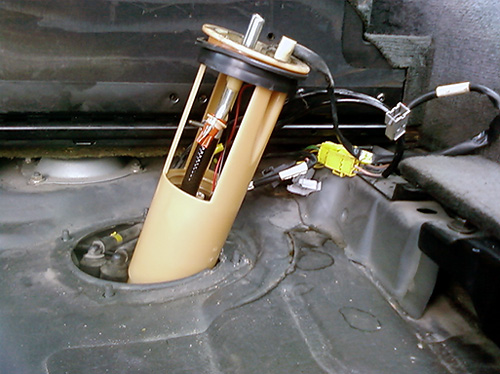
The pump unit is retained by a plastic Mason jar lid retainer ring.
The two fuel lines on the pump unit have to be released with a tool. You can fashion one pretty easily. The tool needs to have a U shaped end bent 90 degrees and with the inside of the U being about 10 mm. The width can't be much over 19 mm for clearance. The most ergonomic affair would be 225mm +/- with the bent end being 19mm and then a 100 mm length to another 90 degree bend for the handle. Each fuel line will need to be pushed inwards, slip tool past the end coupler and then lift to push up the cone shaped spring finger spreader cuff and then release the counter hold so the toll will pull the coupler off the nipple sticking out of the pump unit cap.
The nipple has a flange and the spring fingers in coupler pop past the flange to lock fitting on. The coupler has the cone piece integral that gets lifted to push the fingers back. The fitting needs to pushed deeper onto nipple and held to assure the fingers are not in a bind when you left the release cuff.
The pump units from Volvo have dropped below the price of aftermarket brand units. I got the whole unit from a local dealer that does internet selling for $325. I got a replacement pump and swapped the pump out but the replacement pumps are somewhat universal and have to be fiddled with to fit. Mine failed to pick up fuel when level got below 1/4 tanks so I ended up doing it again and used a new pump unit complete with level sensor for the price I listed.
2. Cutting an access opening in the rear floor where it turns from horizontal and goes vertical.
3. Remove rt side trailing arm, loosening exhaust, removing forward bolt on viscous coupler housing and then lowering right side of tank low enough to exchange pump. BTW, the tank is one piece but has left and right bladders.
The fuel on left is moved to right by what volvo calls an ejector pump. It is not moving parts pump but is a siphoning device where return line fuel is sent through an orifice into a large opening, a venturi of sorts, and the gap between the jet and venturi is oopened to the bottom of tank. The pressure drop sucks fuel but if the left is dry then there is no issue with a dry pump running. The fuel from left is dumped into the pump vessel on RH side and the air rises out of the liquid.
The wires for RH level sensor and pump are under the cover you removed that is access for FWD car fuel pumps.
The pump unit is retained by a plastic Mason jar lid retainer ring.
The two fuel lines on the pump unit have to be released with a tool. You can fashion one pretty easily. The tool needs to have a U shaped end bent 90 degrees and with the inside of the U being about 10 mm. The width can't be much over 19 mm for clearance. The most ergonomic affair would be 225mm +/- with the bent end being 19mm and then a 100 mm length to another 90 degree bend for the handle. Each fuel line will need to be pushed inwards, slip tool past the end coupler and then lift to push up the cone shaped spring finger spreader cuff and then release the counter hold so the toll will pull the coupler off the nipple sticking out of the pump unit cap.
The nipple has a flange and the spring fingers in coupler pop past the flange to lock fitting on. The coupler has the cone piece integral that gets lifted to push the fingers back. The fitting needs to pushed deeper onto nipple and held to assure the fingers are not in a bind when you left the release cuff.
The pump units from Volvo have dropped below the price of aftermarket brand units. I got the whole unit from a local dealer that does internet selling for $325. I got a replacement pump and swapped the pump out but the replacement pumps are somewhat universal and have to be fiddled with to fit. Mine failed to pick up fuel when level got below 1/4 tanks so I ended up doing it again and used a new pump unit complete with level sensor for the price I listed.
-
matthew1

- Site Admin
- Posts: 14803
- Joined: 14 Sep 2002, 11:03
- Year and Model: 850 T5, 1997
- Location: Denver, Colorado, US
- Has thanked: 2857 times
- Been thanked: 1332 times
- Contact:
In addition to what Jimmy said, here are some helpful fuel pump topics. Both will aid you, although the specifics won't match 100%.
1998 XC70 Fuel pump location, removal & replacement
850 wagon Fuel pump location, removal & replacement
How to make a Volvo fuel pump removal tool
Let us know how it goes.
1998 XC70 Fuel pump location, removal & replacement
850 wagon Fuel pump location, removal & replacement
How to make a Volvo fuel pump removal tool
Let us know how it goes.
Help keep MVS on the web -> click sponsors' links here on MVS when you buy from them.
Also -> Amazon link. Click that when you go to buy something on Amazon and MVS gets a cut!
1998 V70, no dash lights on
1997 850 T5 [gone] w/ MSD ignition coil, Hallman manual boost controller, injectors, R bumper, OMP strut brace
2004 V70 R [gone]
How to Thank someone for their post
Also -> Amazon link. Click that when you go to buy something on Amazon and MVS gets a cut!
1998 V70, no dash lights on
1997 850 T5 [gone] w/ MSD ignition coil, Hallman manual boost controller, injectors, R bumper, OMP strut brace
2004 V70 R [gone]
How to Thank someone for their post
-
leonardthefast
- Posts: 7
- Joined: 14 Apr 2012, 19:43
- Year and Model: 1999 S70 T5
- Location: Point Arena, CA.
Thank you ever so much, Jimmy, for your very detailed and specific instructions. I did some searching of the site before posting my initial question and believe I saw a thread where the removal tool you describe is pictured. I will find it again. This is a more or less rhetorical question: Why would Volvo make such a commonly replaceable part so durn inaccessible? Sigh..
I am considering using option 2: Cutting the hole in the right rear floor pan. I've seen where the floor goes vertical in the right rear; do you happen to have an approx. dimension for centerline of the pump ass'y from something inside that I can measure from? Also, approx. how much clearance do I have underneath the floor pan before I cut something I will regret with my Sawzall? Oh, and would I be safer cutting with my small die grinder than with the sawzall? Do I cut the vertical pan only and then rearward towards trunk, or do I cut into the horizontal pan where feet go, after cutting the vertical part, and if so, how far forward do I cut from the vertical? I am assuming I can work with a hole similar in size to the existing one in the trunk where the wires are? TIA
Thank you, Matt, for the very helpful links and pic. I'm 70 years old and I can't for the life of me understand why the good old diaphragm pumps that ran off the camshaft and were right under our noses have been replaced with something that sounds as if it was designed for the ISS! Just kidding, I realize with fuel injection that is no longer an option, still miss them, though.
Cheers,
Leonard
I am considering using option 2: Cutting the hole in the right rear floor pan. I've seen where the floor goes vertical in the right rear; do you happen to have an approx. dimension for centerline of the pump ass'y from something inside that I can measure from? Also, approx. how much clearance do I have underneath the floor pan before I cut something I will regret with my Sawzall? Oh, and would I be safer cutting with my small die grinder than with the sawzall? Do I cut the vertical pan only and then rearward towards trunk, or do I cut into the horizontal pan where feet go, after cutting the vertical part, and if so, how far forward do I cut from the vertical? I am assuming I can work with a hole similar in size to the existing one in the trunk where the wires are? TIA
Thank you, Matt, for the very helpful links and pic. I'm 70 years old and I can't for the life of me understand why the good old diaphragm pumps that ran off the camshaft and were right under our noses have been replaced with something that sounds as if it was designed for the ISS!
Just kidding, I realize with fuel injection that is no longer an option, still miss them, though.Cheers,
Leonard
-
abscate

- MVS Moderator
- Posts: 36148
- Joined: 17 Feb 2013, 17:54
- Year and Model: 99: V70s S70s,05 V70
- Location: Port Jefferson Long Island NY
- Has thanked: 1610 times
- Been thanked: 4065 times
jimmy57 wrote: 15 Apr 2012, 00:07 Three ways exist to get pump out. 1. Volvo method by removal of whole rear suspension subframe with tank sitting on top of it.
2. Cutting an access opening in the rear floor where it turns from horizontal and goes vertical.
3. Remove rt side trailing arm, loosening exhaust, removing forward bolt on viscous coupler housing and then lowering right side of tank low enough to exchange pump. BTW, the tank is one piece but has left and right bladders.
The fuel on left is moved to right by what volvo calls an ejector pump. It is not moving parts pump but is a siphoning device where return line fuel is sent through an orifice into a large opening, a venturi of sorts, and the gap between the jet and venturi is oopened to the bottom of tank. The pressure drop sucks fuel but if the left is dry then there is no issue with a dry pump running. The fuel from left is dumped into the pump vessel on RH side and the air rises out of the liquid.
The wires for RH level sensor and pump are under the cover you removed that is access for FWD car fuel pumps.
The pump unit is retained by a plastic Mason jar lid retainer ring.
The two fuel lines on the pump unit have to be released with a tool. You can fashion one pretty easily. The tool needs to have a U shaped end bent 90 degrees and with the inside of the U being about 10 mm. The width can't be much over 19 mm for clearance. The most ergonomic affair would be 225mm +/- with the bent end being 19mm and then a 100 mm length to another 90 degree bend for the handle. Each fuel line will need to be pushed inwards, slip tool past the end coupler and then lift to push up the cone shaped spring finger spreader cuff and then release the counter hold so the toll will pull the coupler off the nipple sticking out of the pump unit cap.
The nipple has a flange and the spring fingers in coupler pop past the flange to lock fitting on. The coupler has the cone piece integral that gets lifted to push the fingers back. The fitting needs to pushed deeper onto nipple and held to assure the fingers are not in a bind when you left the release cuff.
The pump units from Volvo have dropped below the price of aftermarket brand units. I got the whole unit from a local dealer that does internet selling for $325. I got a replacement pump and swapped the pump out but the replacement pumps are somewhat universal and have to be fiddled with to fit. Mine failed to pick up fuel when level got below 1/4 tanks so I ended up doing it again and used a new pump unit complete with level sensor for the price I listed.
Bumpity bump for the procedure
Empty Nester
A Captain in a Sea of Estrogen
1999-V70-T5M56 2005-V70-M56 1999-S70 VW T4 XC90-in-Red
Link to Maintenance record thread
A Captain in a Sea of Estrogen
1999-V70-T5M56 2005-V70-M56 1999-S70 VW T4 XC90-in-Red
Link to Maintenance record thread
-
- Similar Topics
- Replies
- Views
- Last post
-
- 42 Replies
- 12092 Views
-
Last post by Maestrours
-
- 8 Replies
- 5088 Views
-
Last post by wizechatmgr
-
- 6 Replies
- 1758 Views
-
Last post by vtl
-
- 7 Replies
- 16179 Views
-
Last post by Richard99
-
- 0 Replies
- 752 Views
-
Last post by AustinAbney