Login Register

Simple Volvo Tweeter Modification

Help, Advice and DIY Tutorials on Volvo's P80 platform cars -- Volvo's 1990s "bread and butter" cars -- powered by the ubiquitous and durable Volvo inline 5-cylinder engine.

1992 - 1997 850, including 850 R, 850 T-5R, 850 T-5, 850 GLT
1997 - 2000 S70, S70 AWD
1997 - 2000 V70, V70 AWD
1997 - 2000 V70-XC
1997 - 2004 C70

This topic is in the MVS Volvo Repair Database » Simple Volvo Tweeter Modification
Post Reply
kelvin6
Posts: 284
Joined: 23 June 2005
Year and Model:
Location: San Francisco CA

Volvo Repair Database Simple Volvo Tweeter Modification

Post by kelvin6 »

I'm writing this article, because I still believe in squeezing as much out of the stock system for as little as possible, provided you want to DIY. The modification I performed on the stock dash tweeters would apply for the other speakers in the Volvo that have a tweeter with a (electrolytic) capacitor as a high-pass filter. This is also very commonly found on coaxial speakers (such as my old Infinity 5012i set), and this modification would also apply to those as well.

This modifcation results in better treble response as well as improved clarity from the tweeters. The method of performing this modifcation is removing the dash tweeter, cutting out the old capacitor and replacing it with a film-based capactior which is by far a lot better (more linear) than the Bi-Polar capacitor that was used on the tweeter.

The parts you'll need:

Soldering iron and solder - you will need to do some very simple soldering.
Tin Snippers - to cut off the old capactior

3.3uF (microfarad) WIMA film capacitor - this is the replacement part that you will be soldering in.
^ Sold at mouser.com for $1.63 each without shipping. Part number is 505-MKS23.3/50/10


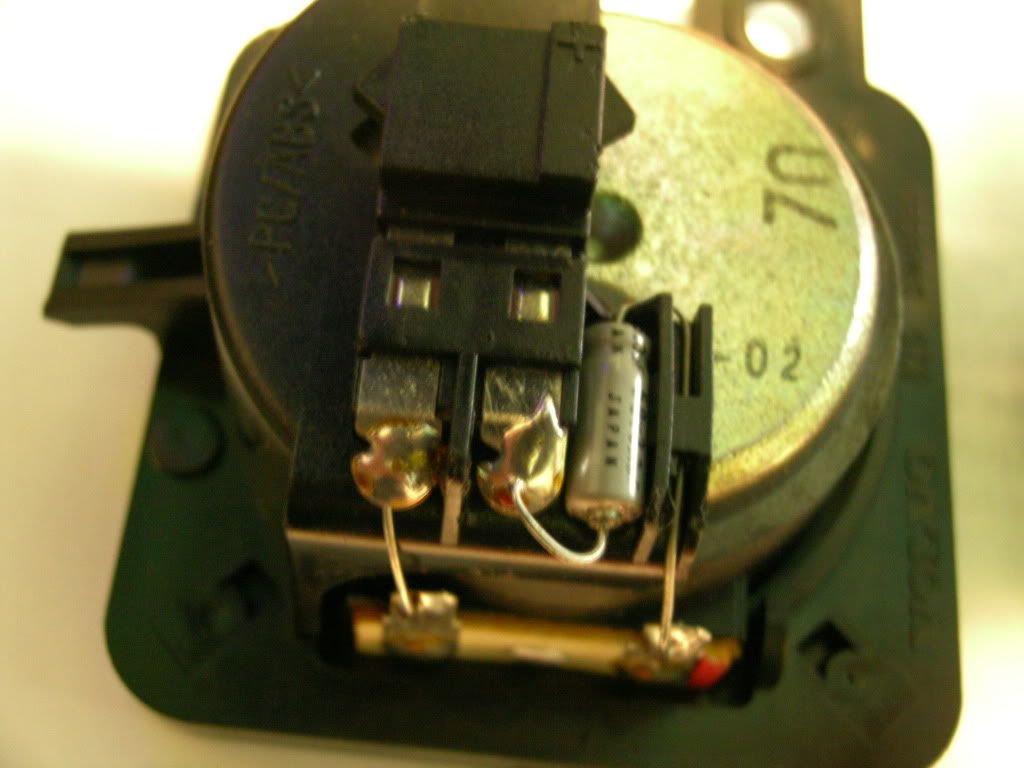
This is how the stock tweeter looks like from the underside. This is from my S70 dash.
Image

The grey cylindrical component is the Bi-Polar capacitor that we want to remove. Snip it out and leave some of the legs of the capacitor on so that we can solder on the replacement film capacitor.


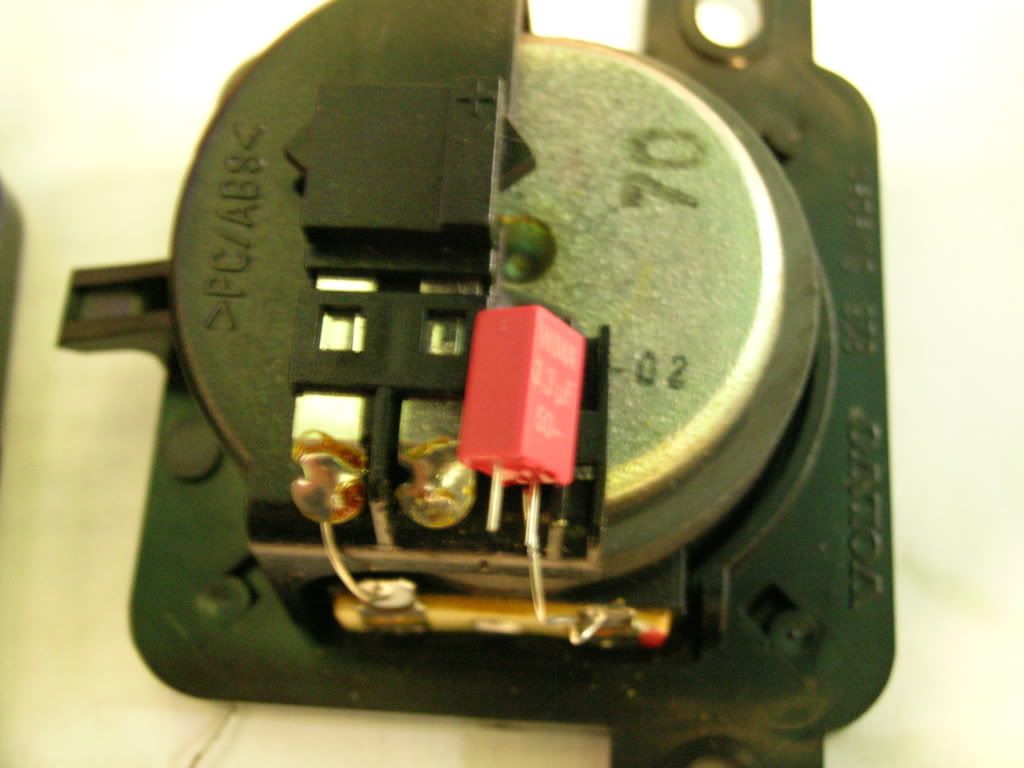
Now place the new capacitor in place, lining up one of the capacitor's legs to the lead on the tweeter:
Image

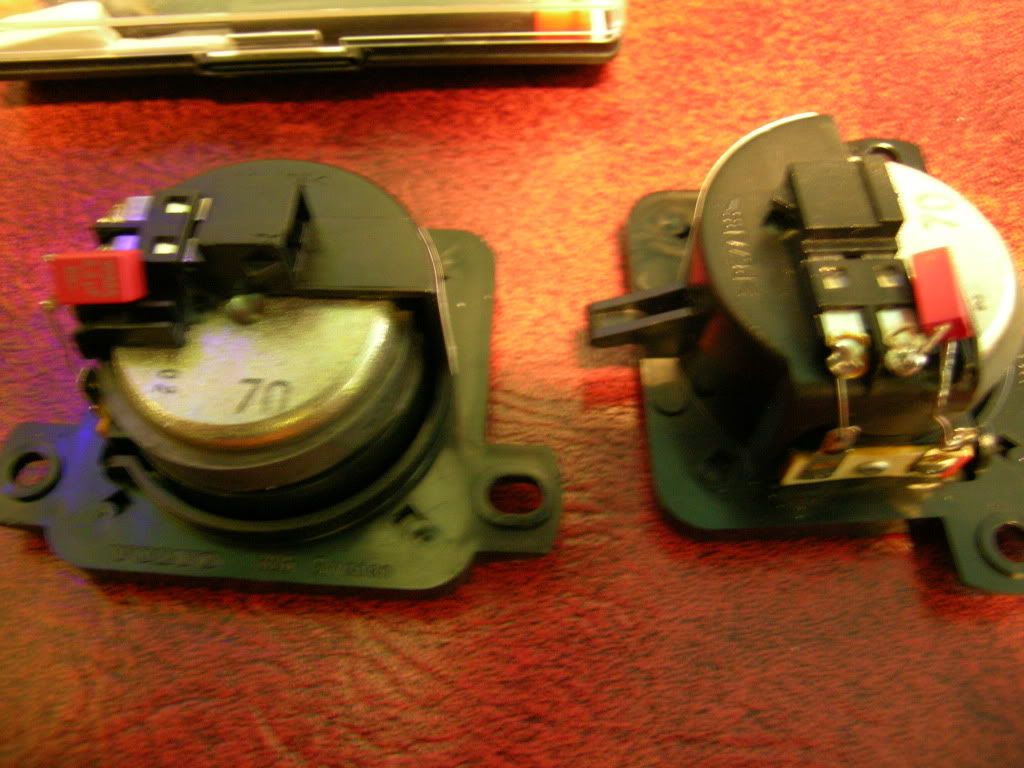
Now solder the leg of the capacitor and lead together. If needed take the old capactior's legs or leads and snip some of it off to attach to the new capacitor so that it touches the tweeter's contacts. If you don't quite understand what I mean, refer to the next picture:
Image

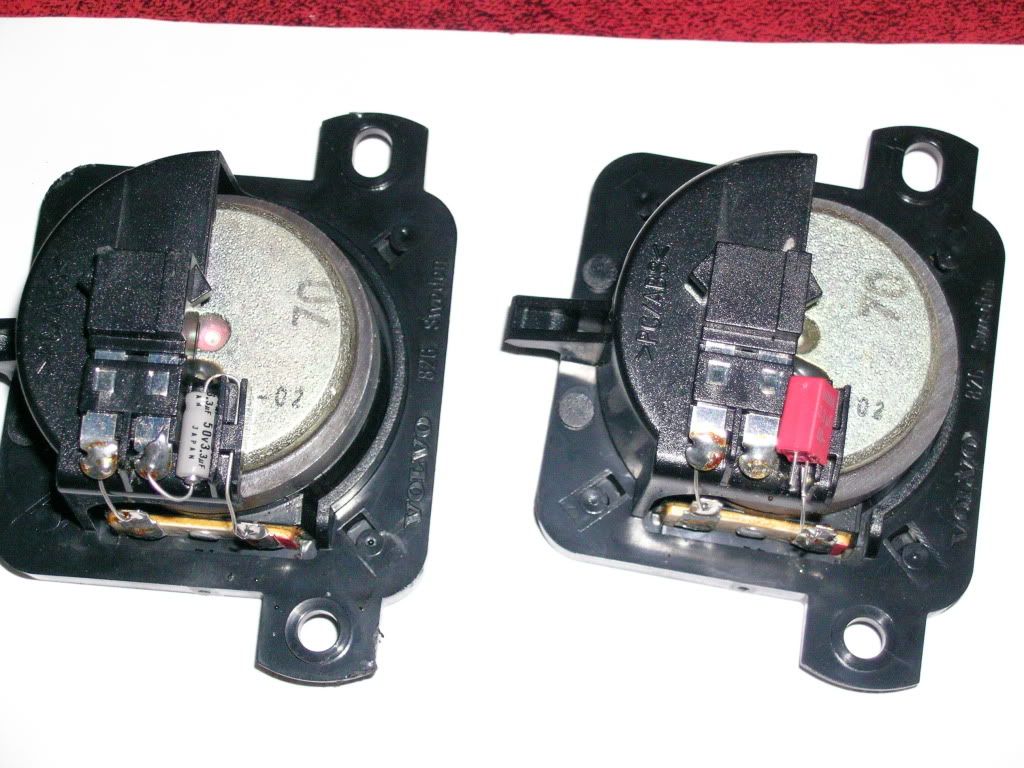
After soldering the other leg on, you should be done! Now do the other tweeter:
Image


This doesn't just apply to the Volvo tweeter, it would apply to many aftermarket coaxial speakers that don't have seperate crossovers. Now saying that, there are probably other speakers in the Volvo that could also benefit from this simple mod, such as the rear door speakers, the rear deck speakers in the sedan or the D-Pillar speakers in the wagon.

If you do attempt to do this for other speakers, try to match the capacitance rating on the capacitor on the tweeter/speaker. A good site to find quality parts is http://www.partsexpress.com and look for cross over capacitors. Try to keep the capacitor leads as short as possible to prevent it from picking interference.
1998 Volvo S70 T5 Auto

1995 Volvo 850 GLT <- RIP

Maestrours
Posts: 79
Joined: 17 November 2022
Year and Model: 03/2000 V70 XC 2.4T
Location: France
Has thanked: 29 times
Been thanked: 9 times

Post by Maestrours »

Hi, thank you for this tip. indeed, sound is much clearer in my tweeters.

Just for eventual readers of this subject (blogged on FCP): back D pillar tweeters on V70 or 850 estates are 4.7 uF, not 3.3 like front ones.

You will need 2 of this one : MKS2B044701K00JSSD

Front one IE number: MKS2B043301H00KSSD

easy job!

User avatar
MoVolvos
Posts: 5270
Joined: 15 January 2012
Year and Model: S&V70XC,S60,C30,XC90
Location: NC
Has thanked: 310 times
Been thanked: 524 times

Post by MoVolvos »

.
Kind of shocked that Volvo would treat the tweeters as full range speakers. Never worked on the Volvo audio system but are there provisions for wires in the head unit for tweeters only or in the amp. Perhaps it’s done at the circuit level already? They should have been blown years ago if that much bass and mids were going trough it.
Blessings,

BKM


2008 C30 T5 2.0 M66
2007 S60 2.5T - New Project
2003 S80 T6 Transmission DIED
2000 S70 SE Base - New Project
1998 S70 T5 Prior
1989 240 Wagon Prior

scot850
Posts: 14864
Joined: 5 April 2010
Year and Model: 2000 V70 R
Location: Calgary, Alberta, Canada
Has thanked: 1836 times
Been thanked: 1709 times

Post by scot850 »

The front speakers are 4ohm if I recall for both door and dash 'tweeters'. Rears are 8 ohm and run in parallel. Or the other way around! I don't remember!

Dug out the thread. It is the other way around:

The front speakers (door and dash) are 8 ohm, the rear door and rear window/tailgate area small speakers are 4 ohms. The rear 4 speakers are wired in parallel for each side. Fronts are individually wired direct.

Neil.
2006 V70 2.5T AWD Polestar tune
2000 V70 R - still being an endless PITA
2006 XC70 - Our son now has this and still parked in our garage
2003 Toyota 4Runner V8 Limited
2015 Kia Sportage EX-L - Sold
1993 850 GLT -Sold
1998 V70 XC - Sold
1997 Volvo 850 SE NA - Went to niece in California - Sold
2000 V70 SE NA - Sold

User avatar
BlackBart
Posts: 6492
Joined: 10 December 2016
Year and Model: 2004 XC70 BlackBetty
Location: Over the far far mountains
Has thanked: 927 times
Been thanked: 884 times

Post by BlackBart »

SO technical. I just keep small byrds in mine. Plenty of tweeting.
ex-1984 245T wagon
1994 850T5 wagon
2004 XC70 wagon BlackBetty

jmartin919
Posts: 298
Joined: 12 July 2013
Year and Model: S70 GLT SE 2000
Location: Durham, NC
Has thanked: 94 times
Been thanked: 39 times

Post by jmartin919 »

MoVolvos wrote: 16 Apr 2024, 09:11 .
Kind of shocked that Volvo would treat the tweeters as full range speakers. Never worked on the Volvo audio system but are there provisions for wires in the head unit for tweeters only or in the amp. Perhaps it’s done at the circuit level already? They should have been blown years ago if that much bass and mids were going trough it.
This procedure replaces the old cap with a better one. Why are you thinking it's seeing full range?
'00 S70 GLT SE
'82 MB 380SL
'11 MB E350 Sport
'84 Chevy C10
'93 850 GLT NA SOLD

User avatar
MoVolvos
Posts: 5270
Joined: 15 January 2012
Year and Model: S&V70XC,S60,C30,XC90
Location: NC
Has thanked: 310 times
Been thanked: 524 times

Post by MoVolvos »

jmartin919 wrote: 17 Apr 2024, 08:47
MoVolvos wrote: 16 Apr 2024, 09:11 .
Kind of shocked that Volvo would treat the tweeters as full range speakers. Never worked on the Volvo audio system but are there provisions for wires in the head unit for tweeters only or in the amp. Perhaps it’s done at the circuit level already? They should have been blown years ago if that much bass and mids were going trough it.
This procedure replaces the old cap with a better one. Why are you thinking it's seeing full range?
.
Details, details! Was doing some speed reading there :oops:.
.
Blessings,

BKM


2008 C30 T5 2.0 M66
2007 S60 2.5T - New Project
2003 S80 T6 Transmission DIED
2000 S70 SE Base - New Project
1998 S70 T5 Prior
1989 240 Wagon Prior

Maestrours
Posts: 79
Joined: 17 November 2022
Year and Model: 03/2000 V70 XC 2.4T
Location: France
Has thanked: 29 times
Been thanked: 9 times

Post by Maestrours »

After a week doing this, the sound is incredibly richer in my 00 V70 XC. I guess the old capacitors had aged not well. i can now hear a clearer high notes and did not think that tweeters can make such a difference. Now installing Dynaudio Woofers to perfect this ...

User avatar
volvolugnut
Posts: 6224
Joined: 19 January 2014
Year and Model: 2001 V70
Location: Oklahoma USA
Has thanked: 927 times
Been thanked: 999 times

Post by volvolugnut »

Capacitors are known to fail after years in place and hours of service. Larger capacitors have service life ratings. You have identified a need to replace the speaker crossover capacitors to renew the original function and sound quality.
volvolugnut
The Fleet:
Volvo: 2001 V70 T5, 1986 244DL, 1983 245DL, 1975 245DL, 1959 PV544, multiple Volvo parts cars.
Mercedes: 2001 E320, 1973 280, 1974 280C, 1989 300E, 1988 300TE, 1979 300TD, parts cars.
2009 Smart Passion
Ford: 1977 F350, 1964 F150 (2), 1938 Tudor Sedan
Farmall tractors: 1956 400 Diesel, 1946 A
And others.

User avatar
MrAl
Posts: 1700
Joined: 8 April 2015
Year and Model: v70, 1998
Location: New Jersey
Has thanked: 83 times
Been thanked: 73 times

Post by MrAl »

Hello Everyone,

I see this thread was resurrected recently from an old old 2010 post. Still an interesting read though, and updates are always nice too.
Since I dealt with these issues almost every day for the past 50 years or more I figured I would add just a little for those interested.

As most of you probably already know, using a single capacitor with a speaker creates a high pass filter where higher frequencies are passed with greater amplitude than lower frequencies. That of course means the 'speaker' gets more highs than lows. This does not mean that the highs get amplified however, it's just that the capacitor blocks out the lower frequencies better than the higher ones. That means that a small speaker would output mostly the higher tones than the lower ones.

The math behind it is rather simple too. The first approximation is a high pass filter with a resistive load. The speaker is taken to be resistive and any signals getting to it must get through the capacitor. It's basically a frequency selective voltage divider.
For a means of understanding the operation and comparison to other filters, the output frequency that causes a minus 3db down signal from the maximum possible signal is considered a good way of understanding how the frequency selective properties work out. It just means that the more important amplitude point is at 1/sqrt(2) of the maximum signal, which is just about 71 percent of the maximum. This ties in with other electrical theories, but for these kinds of applications the 3db down point is a good indication of what the filter can do.

Looking toward this 71 percent factor, the 3db down point for this kind of high pass filter is:
F=1/(2*pi*R*C)
where F is the frequency in Hertz, R the speaker resistance in Ohms, and C the capacitance in Farads, and pi=3.14159...

It is interesting that if we use R=4 Ohms (for the 4 Ohm speaker) and set F=20kHz (usually taken as the limit of human hearing) and solve for C, we get 4uF. That's interesting because that's the value they seem to be using.
If we try that with 8 Ohms however, we get just 2uF. That's also interesting. If we go up to 4uf with an 8 Ohm speaker the result is a 3db down frequency (also called the cutoff frequency) of just 10kHz. What that means is that with an 8 Ohm speaker and 4uf we will be passing more of the lower frequencies, which actually could sound like higher frequencies because of the relationship to other frequencies in the musical piece or spoken words.

So what does all this mean.
It means that the cutoff frequency choice for a given listener may be different for another listener. That's probably the most important point. That means that with a choice of cutoff frequencies, the various listeners may decide on different value capacitors, and it may even be different with different audio content such as music vs speech.

This means that it may be well worth experimenting a little with different value capacitors to see what sounds best. If possible, it would nice to have a selector switch to choose different values. That would be sort of like having a homemade graphic equalizer. Even with an included electronic equalizer though it may still make a difference to use different value capacitors.

In this thread, it's also not entirely clear which values were used for 4 Ohm and which for 8 Ohm speakers. It reads like the value was around 4uF for both, which would say that one speaker type would be passing much lower frequencies than the other. The listener may like that though, and that could mean that using an 8uF for a 4 Ohm speaker may sound better to some people than using a 4uF for that one.

Here's a little plot of the cutoff frequencies vs capacitance for both the 4 Ohm and 8 Ohm speakers. You can see they are not the same.
Note that when using C=4uf, for the 4 Ohm speaker the cutoff is about 20000 Hertz while for the 8 Ohm it's around 10000 Hertz. Using 2uf for the 8 Ohm speaker brings it up to 20000 Hertz, but for the 4 Ohm speaker that would bring it up to 40000 Hertz.

Note these values are for a comparative analysis only. A speaker is actually more complex than a resistor.
Attachments
SpeakerCutoffFrequencies_20240424_083008.png
SpeakerCutoffFrequencies_20240424_083008.png (21.99 KiB) Viewed 951 times
I’ve been driving a Volvo long before anyone ever paid me to drive one.
That's probably because I've been driving one since 2015 and nobody has offered to pay me yet.
1998 v70, non turbo, FWD, base model, on the road from April 2nd, 2015 to July 26, 2023.

Post Reply
  • Similar Topics
    Replies
    Views
    Last post