


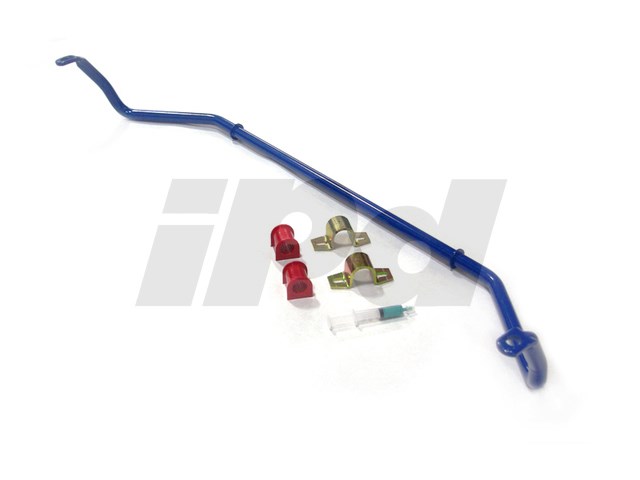
hrahn » They are a good upgrade, but ONLY if the rest of your suspension is in top order.
It makes more sense to first replace all rubber bushings of your suspension setup, get decent shock absorbers etc…
Many people forget the rear axle bushings, they should be replaced if your car dances around with its rear end.
If you already did all of this, and have a tower strut brace installed, the IPD anti sway bars are the next logical step.
My front bar was shot (newer model where the rubber bushings are fixed to the bar), the bushings alone were not readily available and especially not in PU form, so I went for the IPD kit.
Handling got a lot stiffer, I need more force to turn the wheel, but it also feels more precise, more controlled. Hitting the perfect line is much easier now, just have to remember to ease back on the throttle in these winter times – my T5 has wheelspin in 3rd gear when accelerating hard even though I got brand new winter tyres on (the engine isn’t all factory spec anymore though  )
)
precopster » If the shocks are in good condition, the geometry is correct and the car didn’t hit a bump mid corner I would be more likely looking at tyre choice. Body roll generally increases the tyres ability to grip, unless the design of the suspension tilts the road wheel at an angle to the road, as with a live axle. I believe the De Dion suspension fitted to the rear of 850s and S70s limits this from occurring. When we add swaybars and generally limit weight transfer to the outside cornering wheel we can have the reverse effect and require wider, stickier tyres, however on a racetrack at high speed the desire is to limit weight transfer due to the high cornering loads created by speed and let the tyres and suspension limit body roll.
Some tyres are SUBERB in the wet/gravel/high speed and some are average. Some are a compromise in all conditions and some bias toward certain terrain.
My own 960 wagon (live axle) was very skittish in the wet and caught me by surprise numerous times with both standard new 195/65/15s and Avon ZZ1s 235/40/17s on large wheels. I invested in some Conti Pro Contacts 235/45/17s and I have tried to break traction in the wet with no success. These tyres are INCREDIBLE in wet weather.
What tyres are you running on the car and how old are they?
jblackburn » Come to think of it, I have an old set (<2 years) of BF Goodrich Touring T/A’s on the back…I will not be using those tires again. They’re a bit worn down, but not ready for replacement yet. I will probably not rotate them back to the front until winter is over; after that, I’ll put them up front and wear them down until they’re ready to be replaced.
I recently put a set of Yokohama Avid Envigors on the front, and they have incredible traction in just about anything. I have heard good things about the Continentals as well – we actually have them on our Acura Integra. That one is just so light in the rear end though that it will throw out its butt if you go around a corner too fast, dry or wet.
On twisty roads, the big, heavy Volvo will keep up with at the very least or sometimes outcorner the Acura without sliding, something I was pretty surprised to find.
I recently discovered my car already has the ‘sport suspension’ kit that was offered on very few T5 models, with both upgraded front & rear sway bars, so I’m thinking I will just leave those and get a new set of a bit softer shocks (I’m thinking OEM Sachs or Bilstein Touring maybe – it would be nice to have a bit smoother highway ride), which have been due for replacement for a couple thousand miles now.
precopster » Slightly hard tyres & roll stifness can sometimes aggravate a suspension’s tendency to lose traction in the wet.
When racetrack engineers suddenly encounter wet weather, all their dry-weather planning suddenly turns to an all-out rush to soften the suspension and allow more roll.
Phew!! I’m glad I’m not responsible for designing the perfect wet & dry weather vehicle. It’s enough to make somebody lose their hair!! In fact, in my case that’s already happened 
zhenya » My car has a fully sorted suspension system, and I found that the sway bars were overall the biggest improvement to handling that I made. I actually installed the stock sport bars first (my wagon had NO rear swaybar from the factory), but the IPD kit was still a major improvement over them. I am surprised to hear you say that the tail of your car comes around easily – that’s unusual in a fwd car, and a larger rear swaybar is intended to reduce understeer by stiffening up the spring rate on the rear-end. If that’s the problem you are trying to correct, there is likely something else going on.
You mention that you have different tires on the back than on the front – and that you aren’t terribly impressed with the rears. How much tread are left on those rear tires? They could well be the source of your tail-happy condition. On a FWD car, counter-intuitively, you always want the tires with the most traction on the REAR. Otherwise you experience the condition you are describing.
My personal recommendations for suspension improvements would go something like this order (assuming all parts are in reasonable condition and there are no glaringly worn-out pieces):
– swaybars
– tires
– shocks/springs
– strut-bar (of minimal value until everything else is very solid, and if installed correctly, this will actually cause the ride to get significantly harsher – for me, more so than the upgraded suspension).
I have Koni FSD suspension with Eibach springs, and I think this setup is great – it’s how the car should have come from the factory (at least on sportier models). Slightly stiffer and lower than stock, but no harshness whatsoever.
Last Updated on August 23, 2022


1 Comment
Hi Good Day……..I am in search of a stay bar or a stay bar repair kit for the XC 90 T6 Volvo 2005. Can you assist?