


67chevelleSS496 » Never owned a volvo, but looking into getting a wagon soon. I don’t know enough yet to decide on which model and years are preferable.
In my current state of Volvo ignorance, I am leaning towards a ~1996 Volvo 850, mostly because I prefer the exterior aesthetics.
Turbo sounds great, but I have never owned a turbo car and I assume there is a tradeoff for the gains. Do they increase the maintenance costs, reduce drivetrain longevity, double the fuel costs, etc?
I plan on being the only mechanic that works on the car, so if there is a cutoff year when I will need proprietary software interface or whatnot, I would prefer avoid that. I am a mechanic by trade, but not late model cars; just automated industrial machinery and pre-1970 muscle cars and hot rods. I have wrenched on later model cars, but never had to go beyond a generic OBD-II scanner to deal with the computers.
- How well can these things be made to corner and brake?
Is the RWD better in those aspects? - Do the all wheel drive versions bring anything to the table, or do they just complicate maintenance costs?
Anyhow, please help me catch up on what the Volvo enthusiasts already know.
fazool » From your forum name, I see some common background: I also used to wrench on old American musclecars and the defining car of my automotive life was my 67 Chevelle. I bet I have a little understanding of your (automotive) mindset so maybe my perspective can help too.
I owned three Chevelles (67,67,72) so I am a pretty dedicated fan, however, I don’t care for the rounded 68-72 years. I like a square design. The 67 (and 66) Chevelles were boxy and strong looking. Thats what attracted me to my first Volvo – a 740. It was boxy and brawny. I also liked the quad headlights.
Its no suprise (to me) that you like this style.
I had questions about the turbo’s too. In the mid 80’s I bought a brand new turbocharged Pontiac. The turbocharger failed within a year and the maintenance costs were astronomical.
My first, second and fourth Volvo’s are NA (normally aspirated), my third and fifth are turbocharged. I haven’t seen any real difference in maintainence due to the turbo. These are more like the turbochargers on commercial diesel trucks – they last a ridiculously long time and you don’t even think about them as fragile wear items.
I did have one car with a turbo replaced (prior owner did it) but in the past 5+ years neither turbo has even sneezed.
If you do a wiki search on any of those models you will find a nice history page.
There were some transitional models/years (for example the V70XC, etc.) but the list above is the general 1980-2000 ish evolution of the front and read drive lines. The RWD line was replaced by an all new FWD higher luxury S80 car. There are also smaller models and coupes in the history (C70,S40,C30, V50, etc.) But, the models you are interested in are above.
As for maintaining the vehicle, my 740 was the easiest vehicle I’ve ever owned. It was actually enjoyable to work on it. After busting knuckles and fighting rusty everythings, this car was a pleasure to work on. For example, changing the rear brakes: The whole car is zinc coated so the body doesn’t rust, the caliper bolts are yellow chromate plated and contained in a rubber bellows so they never rust. One side is a hinge pin. Unbolt one (never rusty) bolt, swing the calipers up and the pads fall out. Slide new pads in and insert one bolt. I’ve done two-wheel brake jobs in my garage in 20 minutes (and that includes jacking up the car and removing the tires).
The engine compartment is open and accessible. (Most) everything on a Volvo just makes SENSE. Its as if you worked on cars for 20 years then got a different car and every little thing you would have changed to make it better, you did.
The 700 series are like battle tanks and they go forever.
Because of their age, however, you are going to start having trouble finding used parts and junkyards are starting to thin out on their supply.
The ergonomics of the 700 and 850 series are both excellent and comfortable to drive. The 850 insides feels more like an old Chevy with a little more open-ness to the lower half of the car (less cockpit feel than the 700 in my opinion).
The earlier 850’s have an LED “morse code” indicator for engine codes (requires no equipment to read).
I had extensively maintained my RWD 740 and do a fair amount on our FWD 850. Its a real tie. I think the 700’s are easier to maintain and work on, but the 850’s are much better performing and handling and they have better options and features.
The 850’s are super popular and parts are easy to come by and ther eis a lot more “knowledge” out there on the web for the 850’s due to their popularity.
I like the 850 exterior styling a little better. I like the 700 interiors a little better. I like the maintainability of the 700 a little better. I like the availability of parts/info on the 850 better. I like the simplicity of the 700 RWD system better. I like the performance and economy of the 850 FWD system better.
Its a real toss up.
I would reccomend an 850 for availability of parts and info. I would stick to earlier years for self diagnostics.
Also, read this link: How to evaluate a used Volvo
I think I want a Volvo wagon, please educate me 850 Wagon
More about the Volvo 850
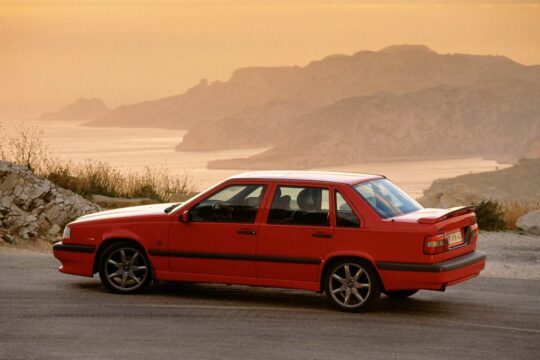
Volvo unveiled an entirely new model series in June 1991, the Volvo 850 GLT. The Volvo 850 GLT was launched under the banner of “A dynamic car with four world-beating breakthroughs”.
The four new features were: transverse 5-cylinder engine driving the front wheels, Delta-link rear axle which combined the dynamics and ride comfort of independent suspension with the security of a live rear axle, the SIPS integrated side-impact protection system, and the self-adjusting front seat belt mechanism.
The exterior design of the 850 bore a strong Volvo identity, and its 740 and 940 heritage was immediately apparent.
Volvo 850 GLT received a tumultuous welcome; seldom has a new car reaped so many awards as the 850.
Over the intervening years, the 850 series has been expanded with additional variants, among them turbocharged petrol versions and a direct-injection turbo-diesel.
The Volvo 850 was also the first car in the world to offer side-impact airbags, which were introduced in autumn 1994.
In model year 1997, the S70 replaced the 850 Sedan car.
Technical Specifications
Model: 850 Sedan
Variants: AWD, T5 R
Produced: 1991 – 1996
Volume: 390835
Body: 4-door sedan
Engine: 5-cylinder in-line DOHC unit, 1,984 cc to 2,435 cc or 5-cylinder in-line 2,461 cc SOHC turbo-diesel
Transmission: 5-speed manual or 4-speed automatic, FWR or AWD
Brakes: Hydraulic, all-round disc brakes
Dimensions: Overall length 467 cm Wheelbase 267 cm
Source
Last Updated on May 22, 2023


1 Comment
I was wondering what size bolts I need to use to put a radiator in a 1996 850 R Turbo Wagon. Thank you.
Mrs. Mendell