


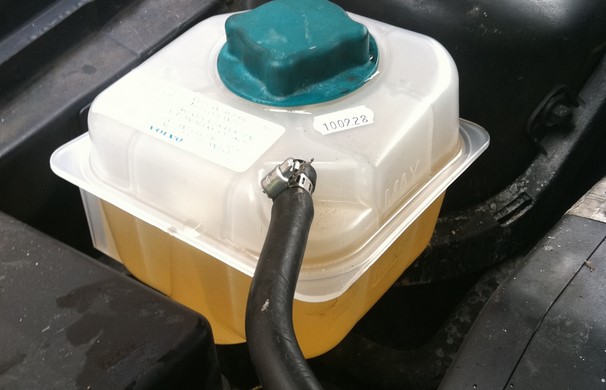
Take that upper line and place it over a bucket. Lift the tank itself directly up off its mounting point off the fender, unclip the sensor line from the side of it and hold it up in the air as far as it will let you; the remaining coolant in that tank will drain through the small line into the bucket. I tried clamping it at first, but it wouldn’t shut off flow. So it holds itself over the bucket! I’m an accidental genius =) Once all the coolant has drained, unscrew the hose from the bottom and remove the little float sensor from the tank.
Replace those into the new tank, bolt it back up, and fill with a 50/50 mixture of coolant and distilled water. As you can see here, I used a small screw-type clamp to replace the one I cut off. You can find them at any auto parts store for like $1 for a pack of a few of them. New tank installed
cn90 »
Some minor little tips to add to this DIY. I have 1998 V70 which has exact same setup as this DIY.
1- For the last few years, I have noticed that I lost 1 cup of coolant per month. I attributed that to evaporation!
Now I know it was coming from the hairline cracks at the bottom of reservoir.
So I strongly recommend people replace their reservoir every 10y/100K miles. It is only $40 at Waltrip Volvo website. And it is genuine Volvo. When it comes to cooling system in any cars, do not gamble with unknown brands!
2- I got all my parts from Waltrip Volvo:
* Reservoir + Cap
* 2 hoses to reservoir
* Tstat and 2 bolts (it is another topic)
* Radiator petcock
3- I need to flush the antifreeze anyway, so I drained from radiator petcock (6-mm Allen key).
Put in new petcock.
Note the small O-ring at the very tip of the petcock, that is what seals the coolant!
4- Note: Hose near firewall —> 7-mm hex to remove clamp.
5- I used Advance Autoparts Coolant (made by Prestone).
6- Note: the Coolant Level Sensor fits in the blind recess at the bottom of the reservoir.
The sensor does not touch the coolant. It senses the level via the magnetic floater inside the reservoir.
7- Once done, fill with 50-50 coolant mix.
– Go for a test drive around the blocks (don’t go too far!) with spare 50-50 coolant in the trunk!
– If you drain from the radiator like I did…..you will need another 0.3 Gallon or so! Just wait until the car cools down to add coolant.
——–
See the pics:
Coolant Expansion Tank replacement on 98 C70 coupe
Welcome to Matthews Volvo Site! Your one stop shop for all Volvo news, help and DIY fixes. We feature the Volvo Repair Database, the best Volvo Forum, and an awesome monthly Volvo newsletter. Joining is always free!
Subscribe to the MVS Newsletter
The MVS Volvo Newsletter is a once-a-month email delivered to your email. It’s simple to unsubscribe at any time if you change your mind.
Last Updated on August 1, 2025




3 Comments
Has anyone had problems with the low coolent light coming on?? And how do I clean the sensor??
My 97 850R had a long crack in the tube (that the hose slips over). For a “weekend fix” I removed the hose, cleaned it all up (had been leaking a lot of coolant)(I love Simple Green). then slipped a piece of Heat Shrink Tubing over the ‘nipple”, carefully shrunk it with hair dryer,let it cool, then slipped the hose back on and clamped it. Its been “as new” for two weeks now, and it made a sanitary “fix”. I’ll be keeping my eye out for a nice original, because I’m sure it’ll let go at the worst possible time…Cars know these things…
2000 V70XC AWD. Well, Matt. I purchased the aftermarket version from a good source on the internet and installed it in July of 2010. No problems, except today, on an out of town trip.
Since installing it, I began noticing the smell of coolant inside the cabin. I kept a wary eye on the heater coil, thinking that may be the culprit. After a while, I concluded that the odor was from the engine compartment. Never saw any leaks, though.
Tonight, after topping off the tank earlier, the low level indicator came on. I pulled over before committing myself to the highway and discovered a drip originating on the underside. Made it home, let it cool and just pulled it.
(By the way, WHO THE HELL IS THE VOLVO ROCKET SCIENTIST who came up with the idea of attaching the power steering reservoir to the coolant bottle with a clip tab and two interfering rims? It’s seems to be a one way in design. Not to mention, locating the coolant bottle UP AGAINST THE INSIDE WHEEL WELL WHERE VIBRATION FROM USE WILL CREATE A WEAR-THROUGH ON THE BOTTLE??!!)
Ok, got that off my chest (though, I hope whoever it was, rots away in a Fiat factory). Anyway, my question, since I cannot locate any problem on the bottle or the main coolant line hose that attaches to the bottom, does Volvo use a pipe sealant on the tank nipple, before clamping the hose down? When replacing it last summer, I noticed a tan residue, inside the end of the hose. I also see something similar on the opposite end of the hose, where it attaches to the metal ‘T’.
Thanks,
leadmann