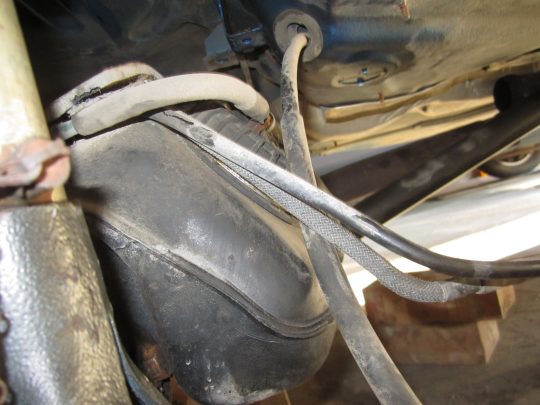
My wife’s 1998 Volvo S70 has been almost impossible to refuel. I checked it and the fuel tank appears to pressurize after a gallon and will kick off the automatic fuel nozzle. When you slightly remove the fueling nozzle you can hear the pressure escaping. It takes a long time to put in even a quarter tank before we give up. I haven’t had a chance to fully diagnose this yet but this problem just started when the S70 passed 100K miles about 4 months ago. Any suggestions?
Brucebo »
polskamafia mjl wrote:
Hmm…I might have a similar problem. Can you shed a little more light about the canister and the line going to it? What does it do first of all, and second where should I look to find the line? the canister itself is towards the front of the engine bay on the driver side I think, right?
Your problem could also be a stuck closed canister shutoff valve. Pressure in the fuel tank is vented to the outside through the charcoal cannister (unless the shutoff valve is closed). The canister adsorbs fuel vapors while letting the air through. During a purge cycle fresh air is pulled, through the open shutoff valve, through the canister into the intake manifold, taking all the adsorbed fuel with it and refreshing the canister. See the following local link:
https://www.matthewsvolvosite.com/forums … &sk=t&sd=a
S70 Fuel Tank Pressurizing when trying to Refuel
The Volvo S70
Introduced in Europe in late 1996 for the 1997 model year and later in the U.S. for the 1998 model year, the Volvo S70 was an updated version of the Volvo 850 saloon. The S70’s body style was overall more rounded compared to its predecessor. Changes included a redesigned front end with new lights, fully colour-coded bumpers and side trim, and clear indicator lenses for the rear lights, as well as a redesigned interior. According to Volvo, a total of 1800 changes were made
Standard equipment was improved with remote central locking, heated & electrically adjustable mirrors, 4 airbags, power brakes with ABS and power windows being standard on every car. Trim levels varied for each market as did the equipment levels of the most basic trims. In the United States, the badging denoted the engine variant and to some extent the equipment level, whereas in Europe engine and options could be chosen individually. On all markets more powerful versions usually received better or upgraded standard equipment. The T5 and R were the series high-performance models.
Subscribe to the MVS Newsletter
The MVS Volvo Newsletter is a once-a-month email delivered to your email. It’s simple to unsubscribe at any time if you change your mind.
Last Updated on May 30, 2025