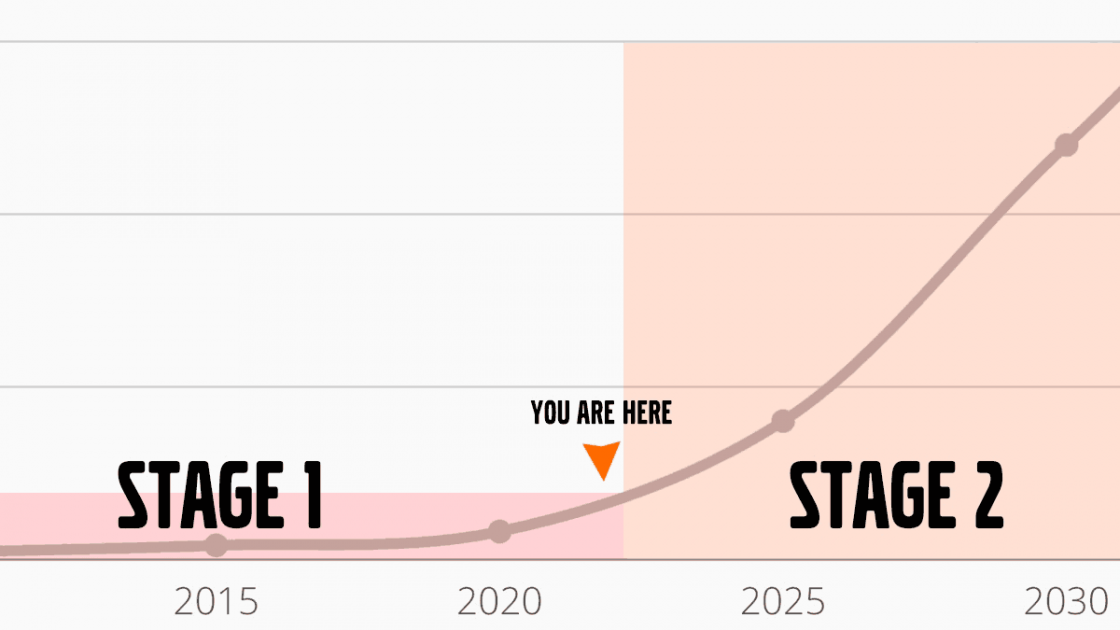
As we move into the end of the first stage of the electric vehicle revolution, note that in the next 12 or so years the rate of change in EV adoption will grow faster than it has before, and faster than it will ever again.
- Stage One, 1-5% new cars sold (we are here)
- Stage Two, 6-75% new cars sold (next year, and through the 2020s)
- Stage Three, 76-99% new cars sold
This post discusses Stage One — why it has lasted over a decade — and predict the near-future of EVs in Stage 2. Please fasten your belt, because things are going to move very, very quickly in the world of EV cars, SUVs, and trucks.
Without further ado, here are the characteristics of the first phase of the EV revolution.
The Tipping Point Is Now
I don’t know if you’re ready for this but here it is: the 120-year era of internal combustion engines in cars and trucks is coming to a conclusion. You’re living in one of the great turning points of the Information Age. I was in my 20s during the Internet revolution, and this move to EVs feels a lot like that.
Internal combustion engine development — and those cars themselves — at major car manufacturers is dropping off or altogether dead, while all major manufacturers are selling EVs today, and planning fantastic new EVs for the future.
The US in 2022 passed an EV tipping point: 5% of new car sales powered only by electricity. Likewise, model year 2022 is the last year you can buy a Volvo powered only by an internal combustion engine. From there on out, it’s full EV or hybrid for Volvos. Polestar has been EV-only for years.
So what has slowed EV adoption thus far?
The answer — more than any other — is because of something called “range anxiety”. Range anxiety is the fear of the EV battery dying while you’re trying to get home, or when you’re out on the interstate between cities.

Whatever the case of the question why the US doesn’t have more EVs on the road today, things are picking up very quickly. We’re just getting out of the first turn in the “S curve” of EV adoption.
The Three Things That HAVE Blocked EV Adoption SO Far
I think it’s helpful to turn the question around, so it’s not “How many EVs are there?” but rather “Why aren’t there more?”
The US has lagged the rest of the high-income developed world in electric vehicle adoption 2010-2020, which is a little strange, since the US is the home of EV leader Tesla.

This chart could signal the US will continue to lag… or it could foreshadow a whiplash effect where the US explodes with great vengeance and furious anger from its long EV slumber as technology, price, range, and charging station ubiquity catch up to what US consumers require to be able to feel comfortable buying an electric car or SUV.
So why isn’t the United States swimming in new EVs already? After all, Americans enjoy the highest GDP of all countries. Three reasons: range anxiety, lack of charging stations, and cost.
“Range Anxiety” — Fading Away Quietly
The opposite of range anxiety is… EV range. As one goes up the other goes down. And range is going up every year, so this has the effect of slowly but surely quieting one of the big EV adoption “pinch points”.
There is no magic range number that when crossed will cause a “snowball effect”, where everybody goes running to their EV dealer to put money down, but range helps people sleep at night. In the mid-2010s there was a 200-mile psychological range threshold. By 2016 Tesla was easily cresting that mark, when the Model S 60 and Model S 60D both had a 200+ mile range, and were not the top-of-the-line Teslas.
Whatever the case, this study published May 2022, says range anxiety is no longer the top concern for shoppers. This is a watershed moment.
I’ve been watching EVs for 10 years, ever since Tesla’s Model S broke onto the market, and the importance of this development can’t be overstated.
Of the 33 cars on this page, only two have less than 200 miles range. One Tesla is in the 400s, and the Lucid Air is over 500 miles. The average American drives 30 miles round-trip commuting to work.
What replaced range anxiety? Price. That will come down slowly as the market begins to serve the low end of the price spectrum. Don’t look to Volvo or Polestar for this, however, because the C40 EV costs $55,000, and Polestar 3 is expected to debut at a wallet-punching $75,000.
EVs Aren’t Cheap
The second of the three reasons we all aren’t driving EVs is price. As is typical in tech, the initial products of a new piece of technology have higher prices, and as adoption goes up price goes down… not to be confused with economy of scale. This is a little different. In this case, EV manufacturers need money because many of them, like Rivian, are dangerously close to failure and insolvency, and the real money is in larger, more luxury vehicles.
So that’s why we got the expensive $96,500 Tesla Model S (in 2012) and $68,500 Rivian R1T first. I’m purposely ignoring the Tesla Roadster in 2008, because that was a very limited-run car… but even then that car doesn’t disprove my point because it was $109,000 in 2008.
Charging Station Ubiquity… or Lack Of
The United States suffers from something called geography… we’ve got a lot of it.
The US is a huge place dotted with cities, but also with vast stretches of nothing between them. The problem with charging stations is mostly in the west and midwest where cities are not spaced close together. And this makes sense: the low-hanging fruit of building stations is putting them in cities, where the revenue is, and that’s exactly where they’ve gone. In the stretches of low population density, they tend to be just common enough so that you can get to the next one on a charge — as long as you’re on an interstate corridor.
Tesla is the clear leader in charging stations with their Supercharger network, and they continue their build-out.

If you want to see non-Tesla charging stations you can use with your non-Tesla EV, go here. Sure, the non-Tesla world of charging while you’re not at home or work is kind of messy. You need to know things like connector type your EV has, so you can make sure you can actually plug it into a public charger, but things are improving.

EV infrastructure like public charging stations tends to be part of a snowball effect: the more EVs on the roads, the more governments and business cater to them. The more charging stations there are, the more likely drivers are to buy an EV. Repeat.

Tesla’s charger is homogenous, so if you have a Tesla it will 100% plug into a Tesla charger. It’ll just work. Non-Tesla EV cars and SUVs have a harder time charging when away from home or work, because there are several competing standards. If this reminds you of the different cell phone standards of the 2000s, you have company. The charger standard will be resolved, with the minimum solution being charging stations providing different port adaptors, and best solution being all the EV makers agreeing on a new make-agnostic standard.
Where are we Now with EV Ownership?
Nobody needs a survey to know people dislike driving in traffic, and dislike filling up at gas stations. Charging your car at home at night is much nicer than filling it up with smelly gasoline at a filling station, while the promise of hands-free driving will make commuting a little less of a chore.
California Has Mandated the End of New Gas-Powered Cars by 2035
California, long the nation’s bleeding edge in automobile regulations, last week mandated the end of internal combustion passenger car sales by 2035. Prior to this, EV adoption was entirely carrot. Now there’s some stick.
Rebates Gave a Huge Push
Rebates got the ball rolling in the US, and they’re still available for some models. Tesla long ago ran out of rebates, but see for yourself the many other brand/model rebates available as of July 2022:
In 10 or 20 years we’ll look back on this first phase and marvel that the US federal government — and some states — actually gave us money to buy these EVs.
Please see the EV rebate chart to determine which EV models are eligible for the $7500 rebate. Or see the official page for Federal Tax Credits for New All-Electric and Plug-in Hybrid Vehicles here.
Please note that the rebates are tax rebates, meaning you get the amount off what you own on your taxes. So if you owe the IRS $10,000, and you get a $7500 rebate, hooray! However if you owe the IRS only $3000, you don’t get the remainder $4500 in cash or next year or ever, you just lose it.
EV Self Driving is Nowhere Near Ready
There are five EV automation levels, as defined by the Society of Automotive Engineers. We’re still in EV automation level 2, despite what you hear from Elon Musk and Tesla (but mostly Musk, sometimes hourly).
To wit: Tesla Autopilot debuts in October 2015, and by 2016 Elon Musk is busy saying an outrageously aggressive prediction:
Tesla CEO Elon Musk tells reporters on a conference call that the Autopilot system is “probably better” than a human driver. He also promises that Teslas will be able to drive significantly better than humans within two to three years, and he says that within two years it will be possible to remotely summon a Tesla from across the country.
Consumer Reports
In 2022, Tesla’s $12,000 $15,000 [it actually went up while I was writing this] Full Self Driving still isn’t anywhere near finished.
Tesla’s self driving is best characterized as “almost there”, or “half-baked”, or “raging fiasco”, depending on where you sit on the topic, and if you paid for FSD.
Because of this, driving automation is clearly a feature destined for the second of the three thirds of the future history of EV transportation. Waymo is arguably ahead of Tesla, but not far enough ahead to provide Waymo with enough confidence to push Waymo taxis nationwide.

To sum up the current state of EV affairs:
- Mandates are now in play
- We got here thanks to rebates
- Self driving technology is nowhere near ready
- Things move quickly with the EV world
Will the Lights Go Out?
I read a lot of material expressing anxiety about the capability of the electrical grid, and I’m here to allay your worries. A large majority of charging is done at home at night, with a small bit done at work during the day. Nighttime EV charging slots elegantly into the electrical grid, which is stressed most during the daytime when people are running their homes’ air conditioning and businesses are open and using electricity.
80% of EV charging is done at home—almost always overnight—or while a car is parked during the workday.
Forbes
This is a serendipitous situation. EVs charge predominately when electricity is most abundant and cheapest. Problem solved.
There is a great deal of opinion on the Internet regarding the US’s electrical grid’s ability to take on widespread EV charging. But it’s not based on math. The grid can handle the foreseeable EV charging load. The lights will not go out.
So What’s Next?
In this chart I make some educated guesses on what the near-future of the electric vehicle looks like, based on where we’ve been.
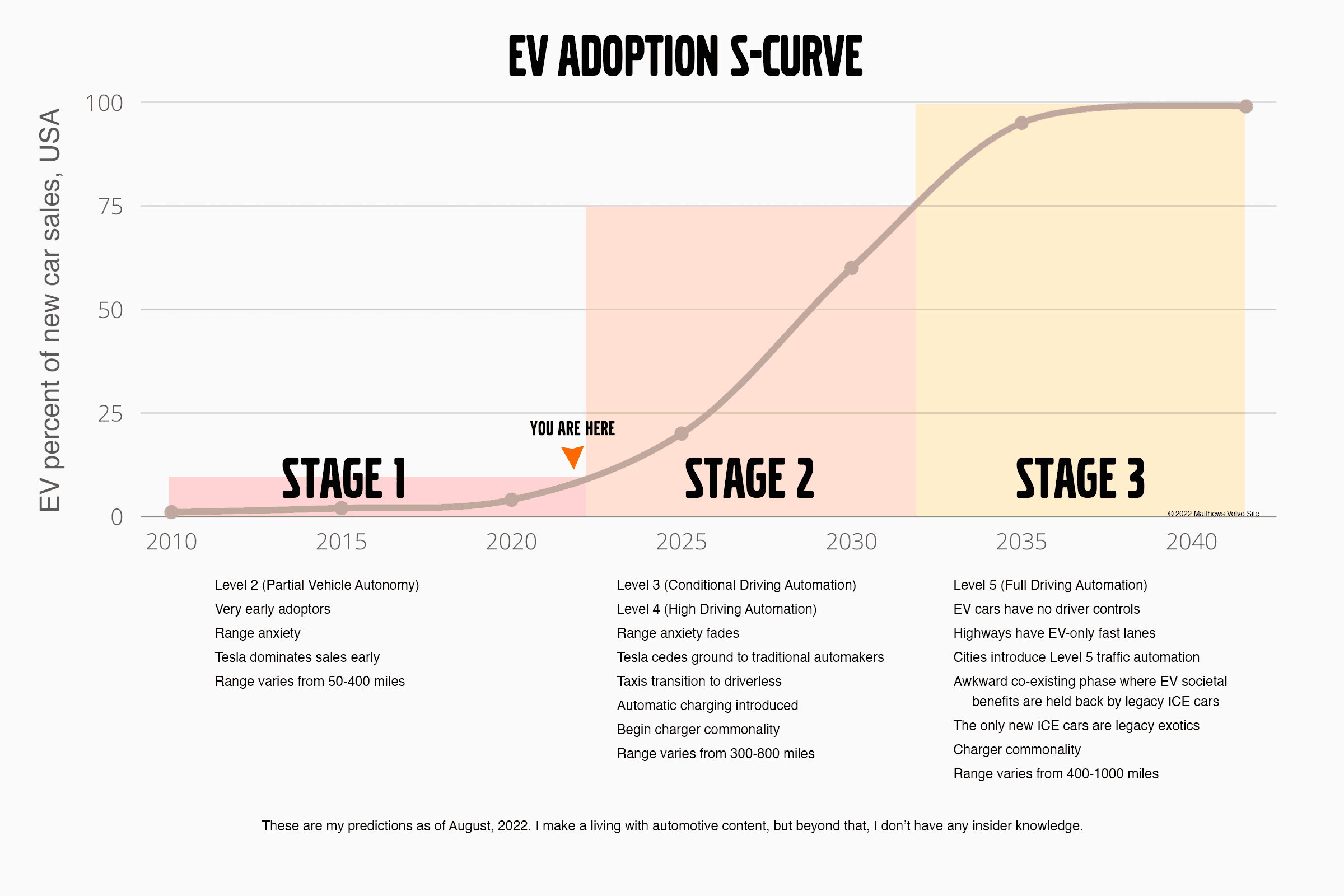
Stage Two, starting in 2023
- Level 3 (Conditional Driving Automation), then…
- Level 4 (High Driving Automation)
- Range anxiety fades
- Tesla cedes ground to traditional automakers
- Taxis transition to driverless
- Automatic charging introduced
- Begin charger commonality
- Range varies from 300-800 miles
Stage Three, starting around 2032
- Level 5 (Full Driving Automation)
- EV cars have no driver controls
- Highways have EV-only fast lanes
- Cities introduce Level 5 traffic automation
- Awkward co-existing phase where societal benefits are held back by legacy ICE (internal combustion engine) cars
- The only new ICE cars are legacy exotics
- Charger commonality
- Range varies from 400-1000 miles
After Stage Three it’s anyone’s guess, but I’m confident these gigantic, historic changes in transportation will help guide society to a better place.

EV Revolution Secondary Effects
Additionally, there will be very interesting secondary effects to the EV revolution, including infrastructure, like things as banal as gas stations.
Demise of convenience stores. Essentially, stores now have to compete to get people to stop, easy when they need gas. Charging at home means no stop at the store for the paper, beef jerky, lotto, or other stuff at 300% margin – gas has been a loss leader or breakeven at convenience stores for a long time now.
Abscate, MVS moderator in this post
Will they come for our ICE cars? No, they won’t come for our ICE cars, as an MVS Forums member explains (and I fully agree with):
It seems the car culture typically makes a knee-jerk reaction to the fuel issue, and of course many of us love our smelly dual-carbed fuel leaks and the noises they make.
BUT….there will not be any banning of fuels in the foreseeable future. No taking-our-cars-away draconian rulings. The market will control that. There are plenty of old (and young) guys (and gals) driving old cars and vintage cars around – some regularly, some on a sunny Saturday, just for fun. Gas costs them a lot more than it did in 1960, of course.
BlackBart, MVS Contributor, in this post
Gasoline May Become LESS Expensive
Of course, nobody knows with certainty what fossil fuel prices will look like in the 2030s, but I’d bet on gasoline taxes going up to force a switch to EVs. The revenue from those taxes will be used for charging stations and EV-only lanes/infrastructure.
The big EV switch changes will not be driven by regulation — “no ICE cars allowed” — but by convenience (full autonomous driving… the carrot) and economic factors like taxes on fuel and annual ICE car registration fee increases (the stick). Greater ICE tax momentum will increase EV adoption rate.
Whatever the case, far into the future, one evening you’ll be sitting with your grandchildren and they’ll ask you about the ICE years. “Did people really pilot cars when you were young, using controls in the car?”
Yes, you’ll say, “You could point the car in any direction with what we called a steering wheel.” They’ll continue, “And people drove off the road, and crashed into other cars and buildings and trees sometimes, by accident?” And you’ll say yes, again.
And you’ll think to yourself what a crazy time that was, what a time of occasional automotive mayhem, but also of freedom and responsibility, and of skinned knuckles and grease and cursing in the garage and lost 10mm sockets. And you’ll miss it, a bit.
Addendum: Rebate Chart as of August 2022
The industry is moving so quickly that even since I included this chart, US president Joe Biden signed the Inflation Reduction Act of 2022 which among many other things changes rebates available to EV buyers starting on January 1, 2023. See this for the upcoming rebate changes.
Until 2023, here’s what’s in play:
| Make and Model | Full Tax Credit |
| AUDI | |
| e-tron Sportback (2020-2022) | $7,500 |
| e-tron SUV (2019, 2021-2022) | $7,500 |
| e-tron GT / RS e-tron GT (2022) | $7,500 |
| e-tron S (Standard and Sportback) | $7,500 |
| Q4 50 e-tron Quattro | $7,500 |
| BMW | |
| i3 Sedan (2014-2021) | $7,500 |
| i3s (2018-2021) | $7,500 |
| i4 eDrive40/M50 Gran Coupe (2022) | $7,500 |
| iX xDrive50/M60 (2022) | $7,500 |
| BYD | |
| e6 (2012-2017) | $7,500 |
| ELECTRIC LAST MILE SOLUTIONS (ELMS) | |
| ELMS Urban Delivery (2022) | $7,500 |
| FIAT | |
| 500e (2013-2019) | $7,500 |
| FORD | |
| Focus EV (2012-2018) | $7,500 |
| Mustang Mach-E (all 2021/2022 trims including GT) | $7,500 |
| E-Transit (2022) | $7,500 |
| F-150 Lightning (standard/extended range) (2022) | $7,500 |
| GENERAL MOTORS (GM) | |
| Not currently eligible for tax credits | ––––– |
| GENESIS | |
| GV60 (2023) | $7,500 |
| HYUNDAI | |
| Ioniq Electric (2017-2021) | $7,500 |
| Ioniq 5 (2022) | $7,500 |
| Kona Electric (2019-2022) | $7,500 |
| JAGUAR | |
| I-Pace (2019-2022) | $7,500 |
| I-Pace HSE (2022-2023) | $7,500 |
| KANDI | |
| EX3 (2019-2021) | $7,500 |
| K22 (2019-2020) | $7,500 |
| K23 (2020-2022) | $7,500 |
| K27 (2020-2022) | $7,500 |
| KIA | |
| Niro EV (2019-2022) | $7,500 |
| Soul Electric (2015-2020) | $7,500 |
| EV6 (58 kWh, 77.4 kWh) (2022) | $7,500 |
| LUCID MOTORS | |
| Lucid Air Dream Edition (2022) | $7,500 |
| Lucid Air Grand Touring (2022) | $7,500 |
| MAZDA | |
| MX-30 (2022) | $7,500 |
| MERCEDES-BENZ | |
| AMG EQS (2022) | $7,500 |
| EQS 450+ (2022) | $7,500 |
| EQS 580 4matic (2022) | $7,500 |
| B-Class EV (2014-2017) | $7,500 |
| MINI | |
| Cooper S E Hardtop 2 & 4 Door (2020-2023) | $7,500 |
| MITSUBISHI | |
| i-MiEV (2012, 2014, 2016, 2017) | $7,500 |
| NISSAN | |
| LEAF (2011-2022) | $7,500 |
| POLESTAR | |
| Polestar 2 (2021) | $7,500 |
| Polestar 2 Long Range – Single & Dual Motor (2022) | $7,500 |
| PORSCHE | |
| Taycan (2020-2022) | $7,500 |
| RIVIAN | |
| R1T (2022) | $7,500 |
| R1S (2022) | $7,500 |
| EDV 700 (2022) | $7,500 |
| SMART USA | |
| EQ fortwo Coupe (2019) | $7,500 |
| EQ fortwo Cabrio (2019) | $7,500 |
| SUBARU | |
| Solterra (2023) | $7,500 |
| TESLA | |
| Not currently eligible for tax credits | ––––– |
| TOYOTA | |
| RAV4 EV (2012-2014) | $7,500 |
| VOLKSWAGEN | |
| e-Golf (2015-2019) | $7,500 |
| ID.4 EV (First/Pro/Pro S) (2021) | $7,500 |
| VOLVO | |
| C40 Recharge Pure Electric (2022) | $7,500 |
| XC40 Recharge Pure Electric (2021-2022) | $7,500 |
Last Updated on September 22, 2022