


Today I visited a decades-old indie Volvo shop and had a good talk with a tech with 15 years experience as a Volvo mechanic. It rocked me, because I thought SPA Volvos were more or less on par with P2 Volvos as far as reliability/repairs go. That is to say: not great, but not in the league of Italian cars. Boy, was I wrong…
I won’t identify the tech or the shop because he asked to go off the record with his name, so henceforth I’ll refer to him as “Bob”. The shop is in the Denver-Boulder metropolis.
I watched closely as the SPA cars were introduced and over the years didn’t see lots of evidence online that they were problematic. I read a fair amount of Volvo news and opinion, and the only hint that these Volvos have their share of trouble came from New Gen Volvo Owners Club. But I figured reading those complaints (and sometimes praise, to be fair) was just another case of Recency Bias or Availability Bias, which is defined as “… the easier it is to recall the consequences of something, the greater those consequences are often perceived to be.” Or both.
As a Volvo forum owner/admin since 2001, I’ve been aware of this phenomenon for a good long time, and I’ve made an effort to not apply what I read to the entire car lineup. I think we all understand that Volvo owners who have 0 problems don’t get on the Internet and write that they have 0 problems. Duh. It’s the owners with problems whose complaints we read, and thus we are tempted to apply that impression onto the entire model or platform.
Today however, Bob spoke at length about SPA models, specifically the second generation XC90, how often he sees them, and how much repairs cost.
Common Expensive Repair Cost Items
- supercharger
- air suspension
- sunroof seal
- intake gasket
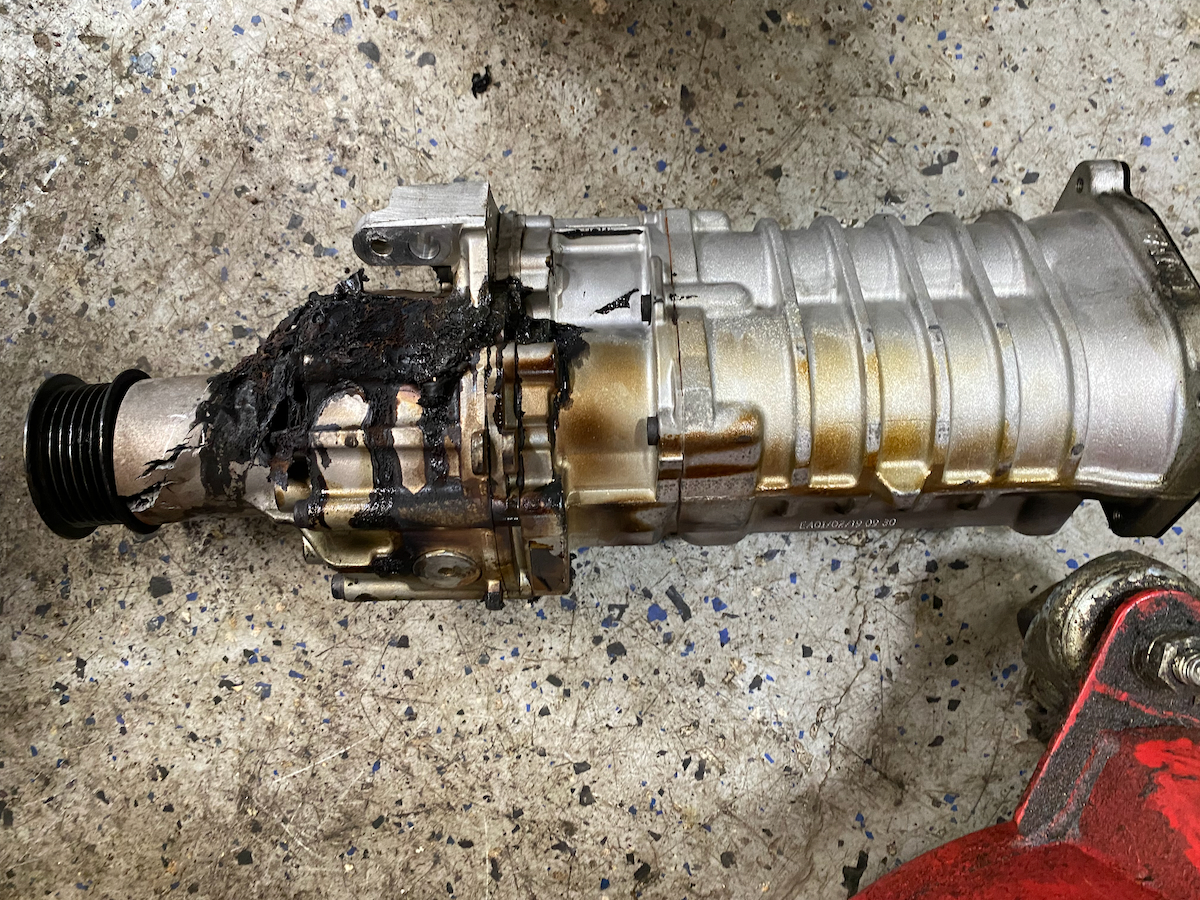
Bob showed me a supercharger (pictured, $1444 new) that he’s replacing on a XC90 that was sitting next to us, and said he’s seen a fair amount of these failures. He went on to say said the air suspension option is a nightmare, with each air spring corner running $1800 to fix (and we thought P2 Volvo’s 4C struts/shocks were expensive at around $400-500 per corner!). The air suspension compressor, which he replaces on customer cars more than he’d like, runs $538.
The SPA XC90’s sunroof seal shrinks over time, causing a gap because after shrinking it’s not a continuous seal. It’s got a cut and is threaded in and around, so when it shrinks that cut grows from 0cm to something greater than 0. Water inevitably gets in through the gap and finds its way to the wiring under the carpet, where water pools. I saw and felt the gap on the XC90 in the shop. It was real and substantial, about 3cm.
But Wait… That’s Not All
In a different case, Bob said the owner’s XC90 was continuously dialing Volvo On Call reporting an accident. He found the fault: shorting wires under the carpet, caused by rainwater, caused by the shrinking sunroof seal. The only real good solution to this was a new interior wiring harness and hours of labor — a brutal $8000 hit. The customer took a pass and traded it in on a different car.
Then he showed me another XC90 in the neighboring service bay that was in for an intake gasket, another common item that requires lots of labor because the turbo has to come out. (I didn’t get the exact part or where it is in relation to the turbo, because by that time my head was spinning.)
At one point I asked him if he would buy a new or used SPA model. “No, not a chance.” Bob will not own an SPA Volvo, even though he can do the labor and get parts at cost.
To illustrate, he asked me the first thought that comes to mind when he said “redblock“. I said “durability.” He said yes of course, those cars regularly run to 400-500k miles, or more in some cases. But he said SPA cars are 100k mile cars. Ooof.
According to Bob, SPA cars rarely come in for an oil change and leave with just an oil change. Usually they leave with additional work, or needing additional work.
Now I know Bob too could be suffering from Recency Bias or Availability Bias, but this scares me. He’s got a good overview of Volvo ownership, being a P2 platform guy himself, so I tend to want to discount the effects of these biases. So I don’t know. Today’s visit gives me a good deal of SPA unease.



3 Comments
Wow, that’s a shame. So I wonder if the sunroof leak is noticeable, people would’ve been noticing wet center console or seats if the gasket up top was leaking, right? And then A/C thing, perhaps a flawed design? And the supercharger, that’s a big oof. But maybe if they resolve these issues (or the Volvo community/parts industry), over time SPA will be reliable. Since my understanding is the first few years of P2 weren’t that great (transmission, throttle body, abs module etc) but the company had enough tries to get it mostly right, and the Volvo community came in clutch to help with the rest. (E.g. Transmission service kits, online rebuild of abs module, etc.) But maybe those early P2s are still considered crappy by the Volvo experts, I’m not sure.
I’m curious how many small Volvo shops won’t work on SPA vehicles because you have to pay for the vida dice subscription to service them. There’s no free hacked version that works on them.
And sounds like the Volvos specifically with the air suspension are turds, in the same way we can say a P2 T6s are turds because of the weak GM transmission.
Every brand and almost every model has some bad things and over time people might learn to avoid the more turd-like SPA Volvos and buy the good ones (or they just get weeded out because the super bad ones eventually go to the crusher). So no air suspension, hopefully a revised sunroof gasket, and I wonder how good a shape a SPA owner would be in.
That won’t fix the labor needed to do services though. If the turbo needs to be removed for the intake gasket, I wonder what other things are like. And what the cause of the supercharger failure is. I’m assuming a factory defect which might be cured in future??
Hi Andy. Water tends to find its way down the inside of the pillars when a sunroof leaks. From there it goes to the floor. I’m sure there are signs, possibly dripping, but I think those are the minority. My suspicion is that the sunroof gasket wasn’t tested in high UV environments over months and years… (if you don’t count testing via actual owners encountering this problem).